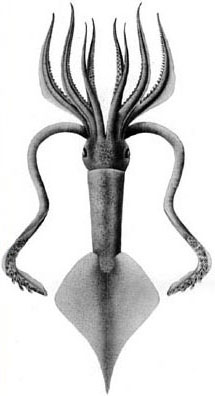
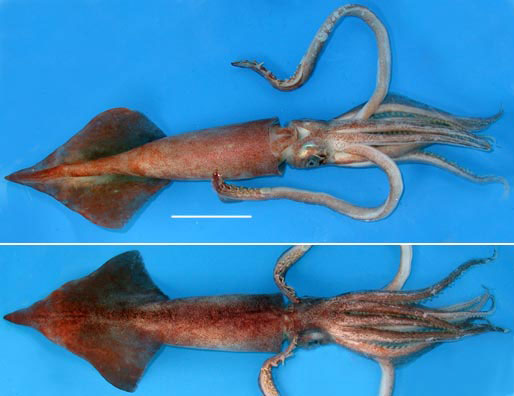
Ancistroteuthis lichtensteinii
An onychoteuthid ...
- without gladius visible beneath skin in dorsal midline.
- with 8-10 occipital folds.
- without suckers on distal portion of club before terminal pad.
- without photophores.
- Tentacles
- Distal suckers on club restricted to terminal pad.
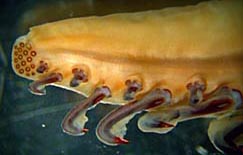
Figure. Oral view of club tip, A. lichtensteinii, type A, 110 mm ML, USNM 294756. Photograph by R. Young.
Photophores
- Photophores absent.
Head
- Beaks: Descriptions can be found here: Lower beak; upper beak.
- Occipital folds number 10 (Naef, 1921-23) or 8 - 9 (Kubodera, et al., 1998) on either side of head.
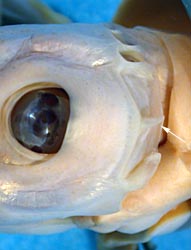
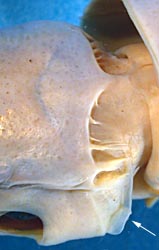
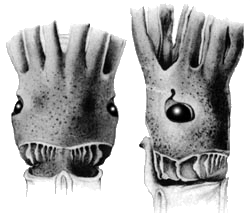 Figure. Left photographs - Lateral and dorsoblique views of the occipital folds, A. lichtensteinii, Type A, preserved, 110 mm ML, 20°27'N, 21°58'W, USNM 294756. Photograph by R. Young.. The white arrows point to occipital fold number 3. Right drawings - Dorsal and lateral views of head and occipital folds, A. lichtensteinii, 145 mm ML, Mediterranean Sea. Drawings from Pfeffer, 1912.Gladius
- Gladius not visible on dorsal side of mantle (i.e., mantle muscle completely surrounds gladius - see title illustrations).
Additional features of the description can be found here.
Kubodera et al. (1998) stated that an oval, opaque area with a small posterior patch of photogenic tissue is present on the ventral covering of the eye. We believe this tissue likely to be iridescent (but not photogenic); observation of live specimens will be necessary to draw any further conclusions.
Kubodera et al. (1998) also briefly described four geographical morphotypes, three forms in the Atlantic and one in the Pacific. The South Atlantic and South Pacific forms, however, belong to Notonykia africanae (Nesis et al. 1998) and Notonykia nesisi (Bolstad 2007) respectively. The other two of their forms are mentioned here as Type A (typical A. lichtensteinii) and Type B; the most distinctive feature of the latter is the rhomboidal, non-attenuate shape of the fins. Insufficient information is available at present to evaluate the significance of these differences.
- Ancistroteuthis
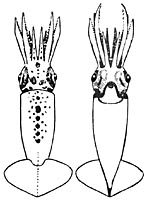
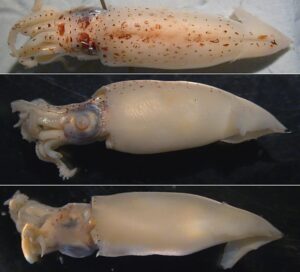 Figure. Dorsal and ventral views of juvenile A. lichtensteinii. Left - 16 mm ML. Drawings from Naef (1921-23). Right - Dorsal, side and ventral views. Photographs by R. Young. The significance of the differences in chromatophore patterns is unknown.
Bolstad, K.S. 2007. Systematics and distribution of the New Zealand onychoteuthid fauna (Cephalopoda: Oegopsida), including a new species, Notonykia nesisi sp. nov. Reviews in Fish Biology and Fisheries, 17: 305–335.
Kubodera, T., U. Piatkowski, T. Okutani and M.R. Clarke. 1998. Taxonomy and Zoogeography of the Family Onychoteuthidae (Cephalopoda: Oegopsida). Smithsonian Contributions to Zoology, No. 586: 277-291.
Naef, A. 1921-23. Cephalopoda. Fauna und Flora des Golfes von Neapel. Monograph, no. 35. English translation: A. Mercado (1972). Israel Program for Scientific Translations Ltd., Jerusalem, Israel. 863pp., IPST Cat. No. 5110/1,2.
Nesis, K. N., M. A. C. Roeleveld and I. V. Nikitina. 1998. A new genus and species of onychoteuthid squid from the Southern Ocean. Ruthenica 8:153-168.
Pfeffer, G. 1912. Die Cephalopoden der Plankton-Expedition. Zugleich eine Monographische Übersicht der Oegopsiden Cephalopoden. Ergebniss der Plankton-Expedition der Humboldt-Stiftung, 2:1-815.
Rancurel, P. l970. Les Contenus Stomacaux d'Alepisaurus ferox dans le Sud-Ouest Pacifique (Cephalopodes). Cahiers O.R.S.T.O.M., serie Oceanographie, 8(4):3-87.
Vecchione, M. and G. Pohle. 2002. Midwater cephalopods in the western North Atlantic Ocean off Nova Scotia. Bull. Mar. Sci. 71(2):883-892.
Voss, G.L. 1956. A Review of the Cephalopods of the Gulf of Mexico. Bulletin of Marine Science of the Gulf and Caribbean, 6(2):85-178.