
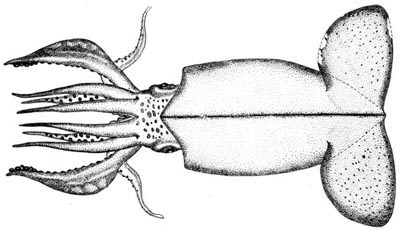
Walvisteuthis virilis
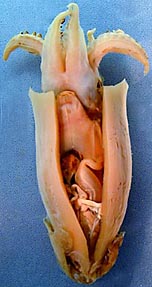
W. virilis is the type species of the genus although presently synonymous with W. rancureli. It was described from a single mature male 71 mm ML taken near the Walvis Ridge, South Atlantic at a depth of 1000 m. Subsequently a second specimen was taken on the opposite side of the South Atlantic but about the same depth that had a GL of 71 mm and also was a mature male. The following account is taken mostly from the original description.
Tentacular club
- Structure unusual perhaps due to partial loss or degeneration (Nesis and Nikitina, 1986).
- Length about equal to arm lengths.
- Tapers toward tip and lacks keels and protective membranes.
- A clear carpal locking-apparatus is present but not surrounded by a skin fold. 8-9 suckers are present. Sucker from the locking-apparatus is shown in Fig. B above.
- Manus with with 5-6 pairs of widely spaced small (0.2mm) suckers on long stalks. Rings with low, rounded teeth all aroung the perimeter.
Arms
- Lenght about half of the ML and in the following order: 4>3=2>1. (Measurements, arms I-IV: 34, 38, 38, 43 mm).
- Protective membranes well developed but low except on ends of arms III.
- Arms III with sucker pairs 12-14 or 15 abruptly enlarged (2X nornal: 2.9 mm), globular. Protective membrane enlarged in this region.
- Tips of arms III devoid of suckers.
- All suckers have tall, narrow, sharp teeth around the entire sucker perimeter. Teeth number about 30-35 on midarm suckers; 20-26 on enlarged arms III suckers.
- Arms IV with modified protective membranes at arm bases: Wide (>half arm width) up to sucker pair 5.
Head
- Occipital folds are absent. Tongue-shaped olfactory organ is present.
Beaks
The upper beak has a strongly recessed jaw angle.
Funnel
- A funnel groove is absent.
Fins
- Short and wide, transversely oval
- Length one third of ML (24 mm).
- Width 90% of ML (62 mm).
Photophores
- Absent.
Gladius
- Gladius bisects the mantle and fins dorsally.
- The free rhachis is about 40% of the GL.
- Vane with thin anterior and thickened posterior margins; widest (16% of GL) point at 72% of the GL from the anterior end.
- Rostrum small (4 mm by 1.7 mm), on dorsal-caudal surface of gladius (see side view, below, right).
Viscera
- Spermatophore
- Spermatophore length: 35 mm
- Spermatophore sperm reservoir: nearly half the SL.
- Spermatophore
- Measurements
Mantle length, mm 71 Head width 20.5 Fin length 24 Fin width 62 Arm I, length 34 Arm II, length 38 Arm III, length 38 Arm IV, length 43 Eye diameter 8.0 Lens diameter 4.3 Sucker diam, arms I and II 1.5 Sucker diam. enlarged, arm III 2.9 Sucker diam, arms IV 1.4
Comments
The ventral view, beak and sucker photographs were taken from a mature male in the collections of the U.S. National Museum. Otherwise, the this description is taken from Nesis and Nikitina, 1986. The peculiar tentacles are probably not intact. Nesis and Nikitina state that possibly the ends were lost and that a reduction of the tentacles has occurred. The second specimen described by Nesis and Nikitina (1992) has a gladius with a rostrum that had a more narrow-triangular shape but with the same orientation as in the holotype. The tentacles are very mutilated but one has a well formed locking apparatus with 8 smooth-ringed suckers.
The type locality is 33° 06.2'S, 02°7.4'E, from the region of the Walvis Ridge in the eastern South Atlantic. It has subsequently been reported from 39°47'S, 43°30'W in the western South Atlantic (Nesis and Nikitina, 1992).
The holotype is a mature male with a large Needham's sac (36 mm long and a maximum 10 mm wide. Nesis and Nikitina (1986) describe the penis as follows: "The penis is very long, tubular, departs from the caudal end of Needham's sac and goes in the beginning perpendicularly and then parallel to it. The length and width of the parallel portion are 24 and 2 mm respectively. The ends of the penis and Needham's sac reach the mouth of the funnel."
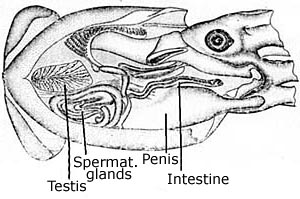
Figure. Ventral view of the mantle cavity of W. virilis, holotype. Drawing modified from Nesis and Nikitina, 1986.
Nesis, K.N., and I.V. Nikitina. 1986. A New Family of Abyssal Squids (Cephalopoda, Oegopsida) from the South-eastern Atlantic. Zoologichesky Zhurnal, 65(1):47-54.
Nesis, K. N. and I. V. Nikitina. 1992. New records of oceanic squids Walvisteuthis virilis Nesis et Nikitina, 1986 and Nototeuthis dimegacotyle Nesis et Nikitina, 1986 (Cephalopoda, Oegopsida) from the South Atlantic and the South Pacific. Ruthenica, 2: 55-58.