
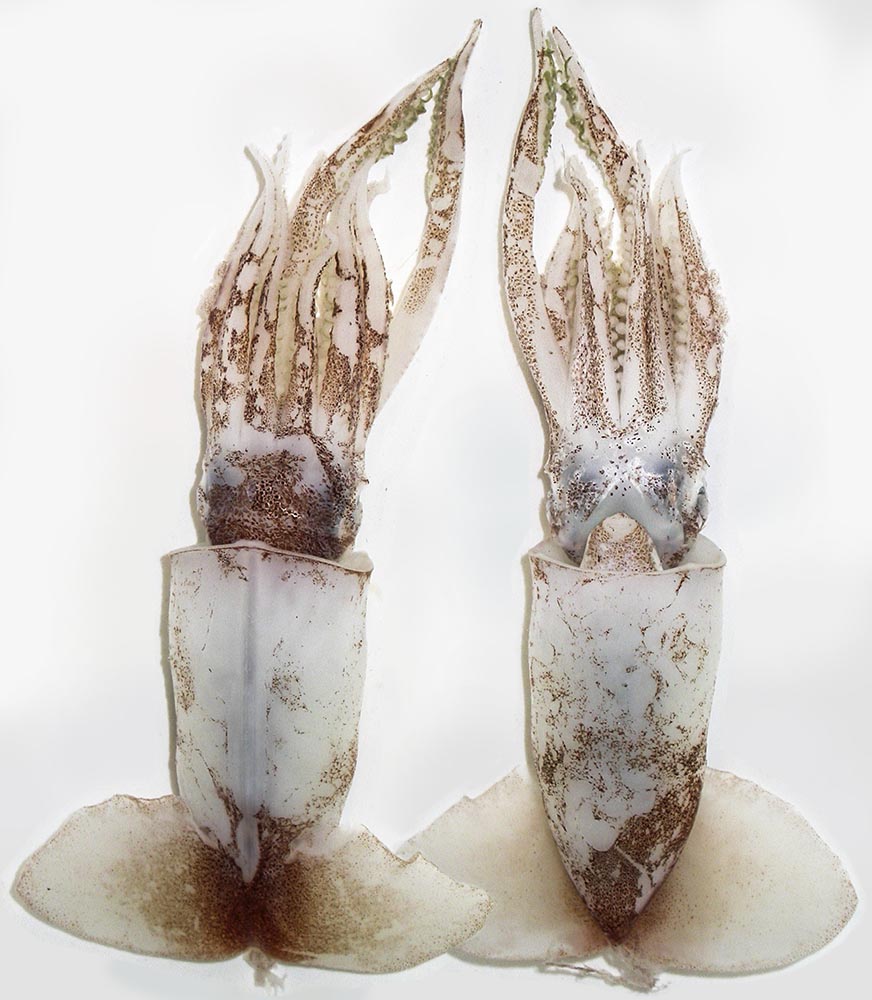
Walvisteuthis jeremiahi
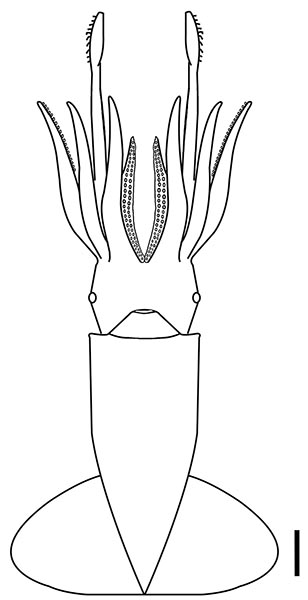
Walvisteuthis jeremiahi is the most recent species to be described in this genus. All members of the genus are very similar and difficult to tell apart. They are all short and plump with no trace of a tail. W. jeremiahi is distinguished from its close relative W. rancureli by statistical differences in counts and measurments (comparison of species is found on the Walvisteuthis page).
Brief diagnosis:
A Walvisteuthis with:
- Club hooks with broad, deep curve.
- 14-22.1-25 (range, bold = mean) hooks on tentacular club.
- 6-7.1-9 (range, bold = mean) carpal suckers on tentacular club.
Tentacles
- Clubs with 14-22.1-25 hooks; each hook sturdy and approximately bilaterally symmetrical.
- Club manus with 4-8 (total) marginal suckers.
- Terminal pad with 2-4 suckers.
- Carpus with 6-7.1-9 suckers and 5-9 knobs.
- Club length 28-40-59% ML.
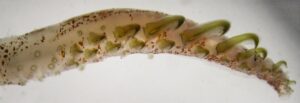
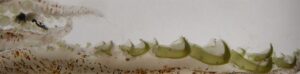
Figure. Tentacular clubs of the holotype of W. jeremiahi, male, 57 mm ML. Top - Oral view of the right club with distal tip damaged. Bottom - Ventral view of part of the left showing a near-profile view of the large hooks. Tips of two arms also visible. Photographs by M. Vecchione.
Arms
- Muscular. Arm formula: III≥IV>II>>I. Arms II-IV ~ 65% ML.
- Suckers biserial; sucker inner rings smooth.
- Arms I with 15-26-40 (range, bold = mean); arms II with 19-28-48 suckers; arms III with 17-28-48 suckers; arms IV with 16-31-48 suckers.
Head
- Head width 26-36-53% ML
Mantle
- Mantle smooth, muscular and stubby; width 33-41-53% ML.
Fins
- Fins short (length 34-42-53% ML), broad (width 81-96-129%ML) and without any posterior medial extension (i.e., no tail).
Photophores
- Photophores absent.
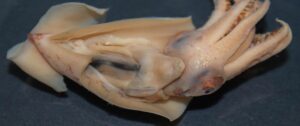
Figure. Ventral view of W. jeremiahi, paratype, male, 44 mm ML with mantle cavity exposed. Note the absence of visceral and ocular photophores. Also note the posterior termination of the mantle and fins without any trace of a "tail." Photograph by M. Vecchione ??
Gladius
- Gladius visible along dorsal midline and with typical Walvisteuthis shape. Maximum width ~28% GL; rostrum laterally flattened, triangular and directed dorsally.
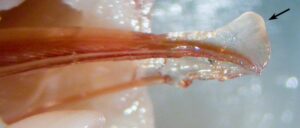
Figure. Ventrolateral view of the posterior gladius of W. jeremiahi, paratype, male, 44 mm ML showing the dorsally directed rostrum (arrow). Photograph by M. Vecchione.
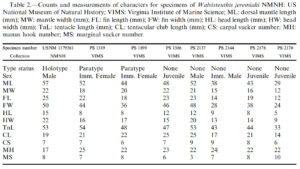
Table of counts and measurements (from Vecchione, et al., 2015).
Type Locality - Gulf of Mexico at 27.8°N, 86.4°W.
Geographical Distribution - Presently known only from the Gulf of Mexico and Gulf Stream waters of the western North Atlantic.
- Vernacular Names: Jeremy squid
Vecchione, M., Sosnowski, A. and Young, R. E. 2015. Walvisteuthis jeremiahi n. sp. (Mollusca: Cephalopoda), an onychoteuthid squid from the Gulf of Mexico. Proceedings of the Biological Society of Washington, 128(2): 164-175. doi:10.2988/0006-324X-128.2.164