Slosarczykovia circumantarctica
General: Slosarczykovia circumantarctica is a relatively large species of squid with a maximum mantle length of ~170 mm. While this species is commonly found around Antarctica, the systematic status has not been critically reviewed (Jereb & Roper, 2010).
Trophic ecology: This species is a common prey item for many Antarctic species including Patagonian toothfish (Cherel et al., 2004), Antarctic fur seal (Abreu et al., 2019), Wandering Albatross (Cherel et al., 2017). A stable isotope analysis was done and showed that Slosarczykovia circumantarctica was segregated from its close relative Brachioteuthis linkovskyi by both trophic position (δ15N values) and habitat (δ13C values) (Cherel & Hobson, 2005).
Behavior: Recent footage from Schmidt Ocean Institute has captured Slosarczykovia changing between white to red colors Slosarczykovia changing colors.
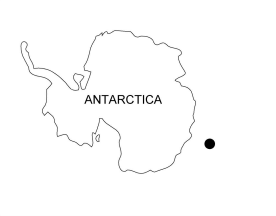
This species displays a circumantarctic distribution.
Type locality: Opposite of Wilkes Land Antarctica.
Epidermis: The fins, mantle, head, and arms are covered in a reticulate integumentary net that is present on both sexes. No tubercles on the mantle of maturing males or females.
Mantle: The mantle is long and relatively slender (mantle width ~19-21 mm mantle length (ML)).
Fins: The fins are rhomboidal, with wider fins than they are long (fin length index ~40% ML, fin width index ~55% ML).
Arms: Arms are short, with males having slightly longer arms in comparison to the mantle length. Arm formula is II>III>IV>I. In females, the sucker rings of arms I-IV are smooth, while males sometimes have 1-4 teeth on arms I-IV. In mature males, there is no presence or sucker enlargement and/or modification.
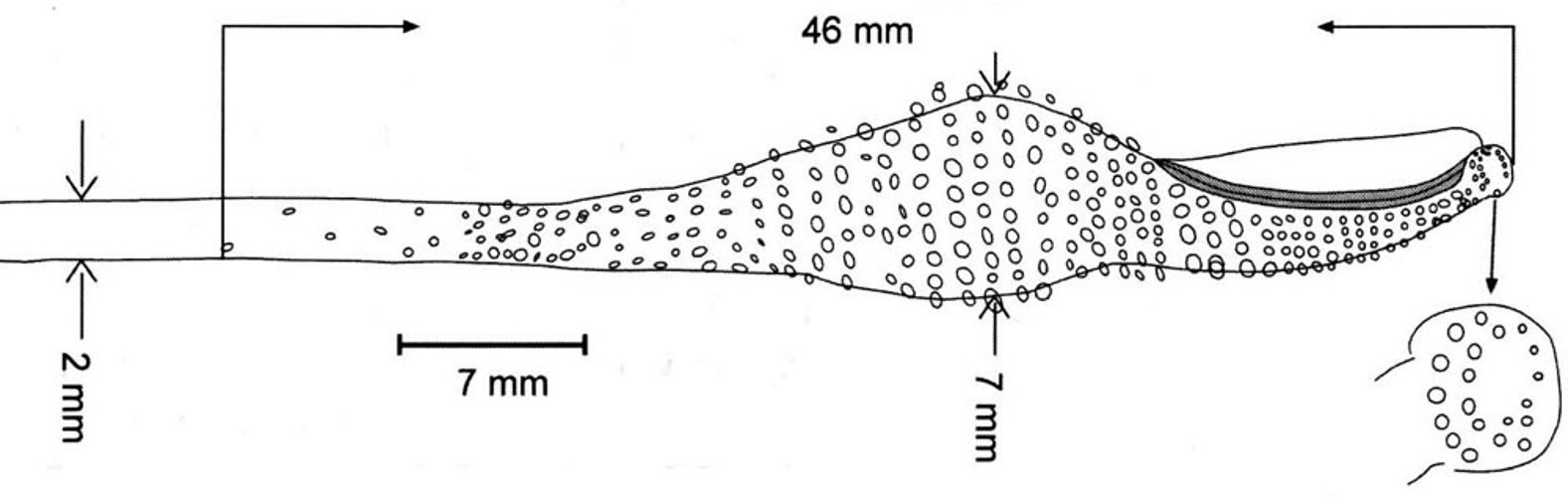
Tentacle: Tentacles are short (tentacle length index ~75% ML) with a long club (club index ~33% ML). Sections of the club are weakly differentiated. Despite carpal suckers being present, there are no adjoining knobs, suggesting that Slosarczykovia lacks a carpal fixing apparatus. The widest section of the club has approximately 10 series of sparsely distributed suckers. The diameter of the largest suckers on the proximal manus are only 1/3rd larger than those of the largest manus suckers.
Gladius:

Abreu, J., Staniland, I., Rodrigues, C. F., Queirós, J. P., Pereira, J. M., & Xavier, J. C. (2019). Squid in the diet of Antarctic fur seals: potential links to oceanographic conditions and Antarctic krill abundance. Marine Ecology Progress Series, 628, 211-221.
Cherel, Y., Duhamel, G., & Gasco, N. (2004). Cephalopod fauna of subantarctic islands: new information from predators. Marine Ecology Progress Series, 266, 143-156.
Cherel, Y., & Hobson, K. A. (2005). Stable isotopes, beaks and predators: a new tool to study the trophic ecology of cephalopods, including giant and colossal squids. Proceedings of the Royal Society B: Biological Sciences, 272(1572), 1601-1607.
Cherel, Y., Xavier, J. C., De Grissac, S., Trouvé, C., & Weimerskirch, H. (2017). Feeding ecology, isotopic niche, and ingestion of fishery-related items of the wandering albatross Diomedea exulans at Kerguelen and Crozet Islands. Marine Ecology Progress Series, 565, 197-215.
Jereb, P., & Roper, C. F. E. (2010). Cephalopods of the world: an annotated and illustrated catalogue of species known to date. FAO Species Catalogue for Fishery Purposes, 4, 51-55.
Lipinski, M. R. (2001). Preliminary description of two new species of cephalopods (Cephalopoda: Brachioteuthidae) from South Atlantic and Antarctic waters. Bulletin of the Sea Fisheries Institute, 1(152), 3-14.
Lipinski, Marek and Richard E. Young. 2019. Slosarczykovia . Slosarczykovia circumantarctica . Version 20 August 2019 (under construction). http://tolweb.org/Slosarczykovia_circumantarctica/24102/2019.08.20 in The Tree of Life Web Project, http://tolweb.org/