
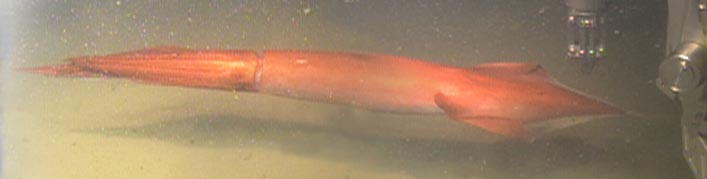
Onykia robusta
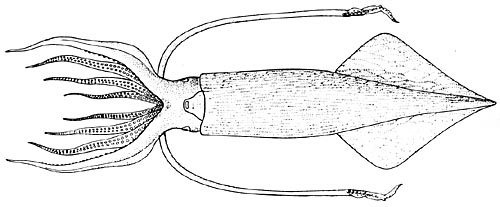
Original name --Ommastrephes robustus Verrill, 1876
O. robusta is the type species of the former genus Moroteuthis and largest species of the genus. It reaches a length of at least 1615 mm ML (Kubodera, et al, 1998). This species is found only in the high North Pacific.
Diagnosis
An Onykia ...
- with sagittate fins (fins drawn-out posteriorly).
- with ridges rather than warts on skin.
Tentacles
- Club with 15-18 pairs of hooks.
Scanning electron micrographs of the hooks can be seen here.
- Suckers of marginal series absent at greater than 61 mm ML.
Head
- Beaks: Descriptions can be found here: Lower beak; upper beak.
Mantle
- Dermis of mantle skin with longitudinal ridges.
Fins
- Sagittate shape beyond 94 mm ML.
- Length 50-65% of ML.
- Width 60-70% of ML.
Gladius
- Rostrum 25-40% of GL; opaque, circular in cross-section.
- Rostrum 25-40% of GL; opaque, circular in cross-section.
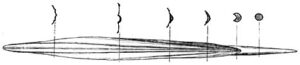
Figure. Ventral view of gladius of O. robusta with cross-sections. Drawing from Sasaki 1929.
This species is found in the temperate to boreal North Pacific (Kubodera, et al., 1998)
O. japonica (Taki, 1964) and O. pacifica (Okutani, 1983) are junior synonyms (Tsuchiya and Okutani, 1991).
- Moroteuthis robusta
- Ommastrephes robustus
- Onykia japonica
- Onykia pacifica
At less than 43 mm ML, the mantle has an irridescent epidermis overlying numerous indistinct ridges; at 61 mm ML, the mantle surface has fleshy ridges and a weak iridescence; at 94mm ML no iridescence remains. The shape of the fins changes greatly with growth from oval in combined outline at less than 20 mm ML to saggitate in adults. The rostral cap is 20% of the ML at 43 mm ML and 30% at 100 mm ML. The inverted Y-shaped ridge is detectable in specimens larger than 60 mm ML. By 61 mm ML all marginal suckers on the club are absent. This life history data is from Tsuchiya and Okutani, 1991.

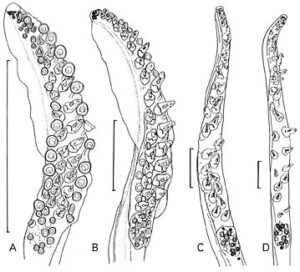
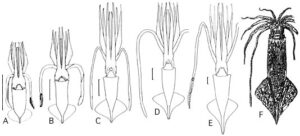
Figure. Ventral views of O. robusta at various sizes. A - 19.4 mm ML. B - 42.8 mm ML. C - 60.7 mm ML. D - 135 mm ML. E - 181 mm ML. F - 1615 mm ML. Scale bar = 2 cm. Drawings from Tsuchiya and Okutani (1991, p. 139).
Changes in body form are reflected in changes in the shape of the gladius.
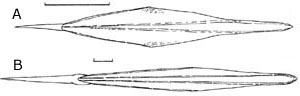
Figure. Ventral views of the gladii of O. robusta. A - 42.8 mm ML. B - 181 mm ML. Drawings from Tsuchiya and Okutani (1991, p. 142).
T. Kubodera, U. Piatkowski, T. Okutani and M.R. Clarke. 1998. Taxonomy and Zoogeography of the Family Onychoteuthidae (Cephalopoda: Oegopsida). Smithsonian Contributions to Zoology, No. 586: 277-291.
Tsuchiya, K., and T. Okutani. 1991. Growth Stages of Moroteuthis robusta (Verrill, 1881) with the Re-evaluation of the Genus. Bulletin of Marine Science, 49(1-2):137-147.