
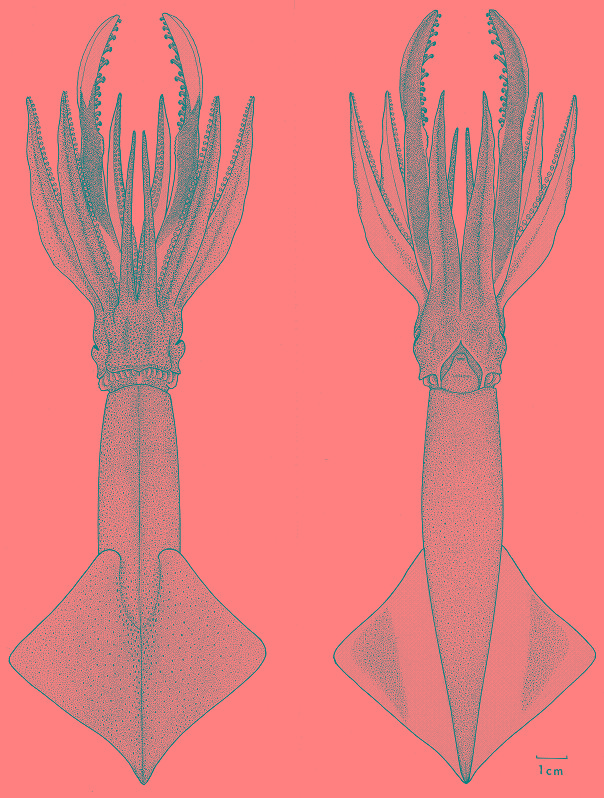
Onychoteuthis prolata
Onychoteuthis prolata was recently disambiguated from the O. banksii complex. Young and Harman (1987) described the paralarva (species B) from Hawaiian waters; later ontogenetic stages were formally described by Bolstad, Vecchione & Young in Bolstad (2008). The most distinctive feature of this species is the tentacle club, which is extremely long for an Onychoteuthis (35-40% ML).
Diagnosis
An Onychoteuthis species...
- with tentacle club length 35-40% ML.
- without spikes on the distal ventral hooks.
- with chromatophores along the ventral ridge on the oral surface of the tentacle stalk.
- with chromatophores on all portions of the mantle ventrally (no 'bald spot').
- without fleshy knobs on the distal margin of the arm suckers.
Tentacle club
- Length ~36% ML, with 20–23 long, robust, strongly recurved hooks.
- Distal-most ventral hook bases not produced into spike.
- Chromatophores present across oral face of tentacle stalk proximal to carpus and along oro-ventral tentacle stalk ridge (arrows in second image below).
- Two circular intestinal photophores present. Anterior photophore 50-75% diameter of posterior photophore.
- Ocular photophore a long whitish patch on ventral surface of each eyeball.
Measurements of holotype
- Mantle length - 135 mm
- Arm lengths - 53-71 mm
- Fin length - 81 mm
- Fin width - 89 mm
- Club length - 54 mm (left)
- Club hook numbers - 23
- Largest hooks - Hooks V5 and V6
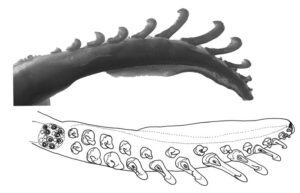
Onychoteuthis prolata. © K.S. Bolstad
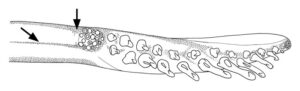
Onychoteuthis prolata. Arrows indicate chromatophores present across oral face of tentacle stalk proximal to carpus and along oro-ventral tentacle stalk ridge. © K.S. Bolstad
Bolstad, K.S. 2008. Two new species and a review of the squid genus Onychoteuthis Lichtenstein, 1818 (Oegopsida: Onychoteuthidae) from the Pacific Ocean. Bulletin of Marine Science, 83: 481–529.
Young, R.E.; Harman, R.F. 1987. Descriptions of the larvae of three species of the Onychoteuthis banksii complex from Hawaiian waters. Veliger 29(3):313–321.