
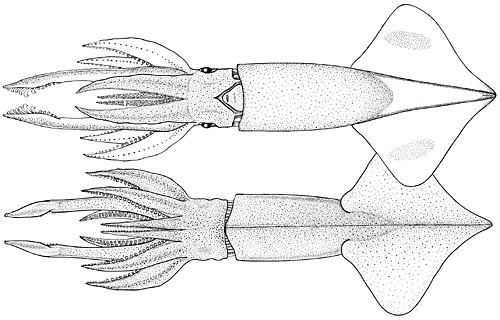
Onychoteuthis compacta
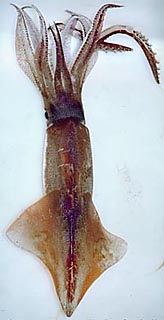
O. compacta appears to be the most common of the three species of Onychoteuthis found in Hawaiian waters. It is most easily identified by characteristics of its pigment pattern. Juveniles and subadults have a distinctive region on the posteroventral surface of the mantle that lacks chromatophores.
Tentacular club
- Club without marginal suckers in subadults.
- Distal 4 or 5? fully-formed hooks in ventral series with spikes (see arrow) that protrude through the skin.

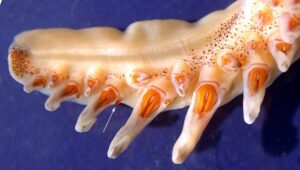
Figure. Oral views of tentacular club of O. compacta. Top - Original drawing by Keiko Hiratsuka Moore, National Marine Fisheries Service. Distal portion of club showing hook spikes (arrow), preserved. Photograph by R. Young.
- Beaks: Descriptions can be found here: Lower beak; upper beak.
- Beaks: Descriptions can be found here: Lower beak; upper beak.
Mantle pigmentation
- Triangular-shaped region on the postero-ventral mantle lacks chromatophores.
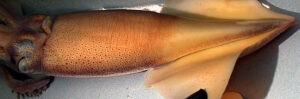
Figure. Ventrolateral view of the mantle of O. compacta, preserved, showing pigmentation, Hawaiian waters. Photograph by R. Young.
Until recently, known only from the Central Pacific, primarily 30°N–30°S; Bolstad (2010) reported additional material from the western north-central Atlantic, primarily 0–40°N. Probably worldwide in tropical to warm temperate oceans. Depth distribution unknown; majority of specimens collected at surface.
Paralarvae of O. compacta are easily identified by the arrangement of their chromatophores. At 3-4 mm GL: A simple band (i.e., a single, straight line) of chromatophores is present along the free ventral margin of the mantle; a group of chromatophores is situated well posteriorly on the ventral mantle and two large chromatophores are located ventrally opposite the fins. At 6 mm GL: Two pairs of chromatophores are present on the ventral mantle adjacent to the fins. A small patch of chromatophores is present dorsally at the posterior convergence of the fins. At 9 mm GL: Two parallel rows of small chromatophores are located dorsally stradling the midline of the mantle. At 12-16 mm ML: Chromatophore numbers increase dramatically. At 18 mm ML: The subadult chromatophore pattern can be recognized.
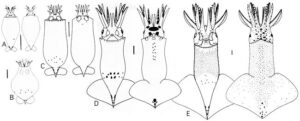
Figure. Ventral and dorsal views of paralarval and juvenile O. compacta. A - 2.3 mm GL. B - Ventral view of a common condition in this species: head retracted within the mantle cavity, 4.8 mm GL. C - 4.1 mm GL. D - 8.9 mm GL. E - 18.5 mm GL. The bar is 1 mm. Drawings from Young and Harman (1985).
Berry, S. S. 1913. Some new Hawaiian cephalopods. Proc. U. S. Nat. Mus. 45: 563-566.
Bolstad, K.S.R. 2010. Systematics of the Onychoteuthidae Gray, 1847 (Cephalopoda: Oegopsida). Zootaxa, 2696: 186 pp.
Kubodera, T., U. Piakowski, T. Okutani and M. R. Clarke. 1998 Taxonomy and zoogeography of the family Onychoteuthidae. Smiths. Contr. to Zoology, No. 585: 277-291.
Young, R. E. and R. Harman. 1985. Descriptions of the larvae of three species of the Onychoteuthis banksii complex from Hawaiian waters. The Veliger, 29: 313-321.