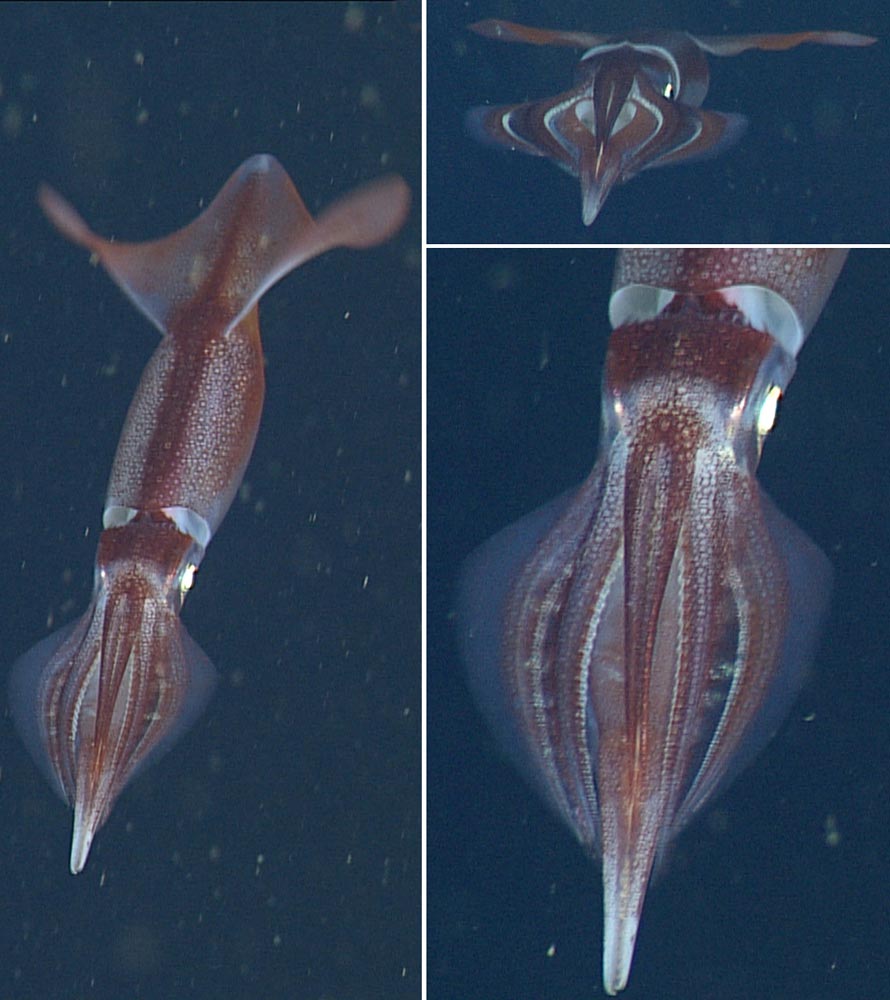
Onychoteuthis borealijaponica
Onychoteuthis borealijaponica is the most abundant onychoteuthid in the temperate to boreal North Pacific. It is the largest member of the genus, reaching a ML of 350 mm. The large number of hooks on the tentacular clubs, the most of any member of the genus, allows easy identification.
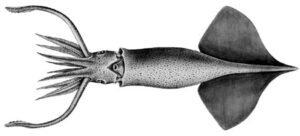
Figure. Oral view of O. borealijaponica, 50 mm ML. Drawing from Young (1971).
Diagnosis
An Onychoteuthis species...
- with 24-27 hooks on tentacular club.
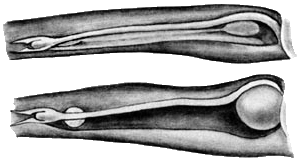
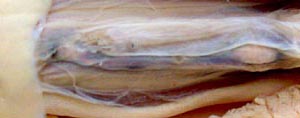
- with two oval or teardrop-shaped intestinal photophores
Tentacular club
- Club with 24-27 hooks.
- Club without any marginal suckers in subadults.
- Several distal ventral-series hooks have spikes (arrow in bottom photograph points to most obvious spike).
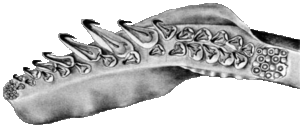
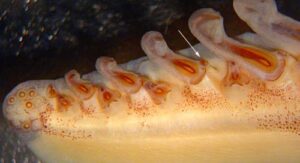
Figure. Oral views of the tentacular club of O. borealijaponica. Top - Full club, 81 mm ML, off southern California. Drawing from Young (1972). Bottom - Distal portion of preserved tentacular club, 175 mm ML, 45°N, 175°W. Photograph by R. Young.
Head
- Beaks: Descriptions can be found here: Lower beak; upper beak.
- Beaks: Descriptions can be found here: Lower beak; upper beak.
Photophores
Visceral photophores slender: Posterior visceral photophore width ave. 61% of length (range 53-69%).
The type locality is the waters off Japan. This species occurs in the North Pacific from the Aleutian Islands to southern Japan and Baja California (Nesis 1982/87).
O. borealijaponica migrates into subarctic waters to feed during the summer and returns to subtropical waters for spawning in fall and winter; males mature at about 250 mm ML and females at 300-350 mm ML (Kubodera et al. 1998).
Kubodera, T., U. Piakowski, T. Okutani and M. R. Clarke. 1998 Taxonomy and zoogeography of the family Onychoteuthidae. Smiths. Contr. to Zoology, No. 585: 277-291.
Nesis, K. N. 1982/87. Abridged key to the cephalopod mollusks of the world's ocean. 385+ii pp. Light and Food Industry Publishing House, Moscow. (In Russian.). Translated into English by B. S. Levitov, ed. by L. A. Burgess (1987), Cephalopods of the world. T. F. H. Publications, Neptune City, NJ, 351pp.
Young, R. E. 1972. The systematics and areal distribution of pelagic cephalopods from the seas off Southern California. Smithson. Contr. Zool., 97: 1-159.