
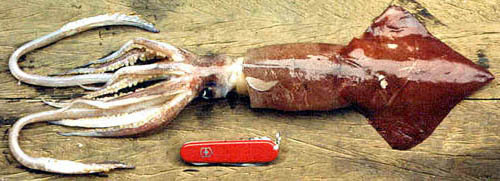
Filippovia knipovitchi
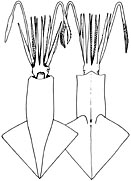
- with smooth skin (no warts, ridges or welts)
- with no secondary (dorso-lateral) occipital folds or photophores
- with a U-shaped funnel groove (and no Y-shaped ridge)
- with asymmetrical ventral tentacular hooks
- with all arms subequal, or Arms I shortest by ~5% ML
Tentacles
- Club with 10-15 (Kubodera et al., 1998) or 13 (Filippova, 1972) pairs of hooks.
- Long, slender hooks of ventral series have asymmetrical bases (see drawing below).

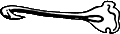
Figure. Oral view of tentacular club and large club hook of F. knipovitchi. Drawings from Filippova, 1972.
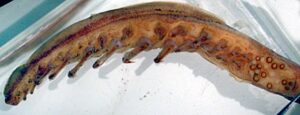
Figure. Oral view of tentacular club of F. knipovitchi, 295 mm ML, female. Photograph by R. Young.
Head
- Beaks: Descriptions can be found here: Lower beak; upper beak
Mantle
- Skin smooth (i.e., no welts or ridges) (photograph of anterolateral mantle skin at right).
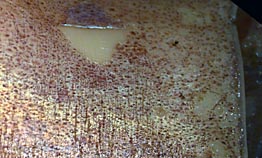
Figure. Portion of skin on anterodorsal mantle of F. knipovitchi, 295 mm ML, female. Photograph by R. Young.
Fins
- Rhomboidal shape, not drawn out into a tail.
- Length 50-60% of ML.
- Width ~70% of ML.
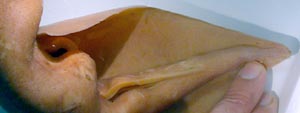
Figure. Ventral view of fin of F. knipovitchi with indication of rostrum length, 295 mm ML, female. Photograph by R. Young.
Gladius
- Rostrum short, 1/12th of GL (measured from ventral edge of conus); triangular in cross-section (dorsal surface flat, ventral surface pointed).
- Keel thickened posteriorly.
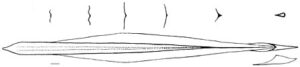
Figure. Ventral view of gladius F. knipovitchi with cross-sections. Drawings from Filippova, 1972.
Comments
Except where noted, this description is taken from Filippova (1972). The slender, asymmetrical hooks, smooth skin, homodont radula (see next page) and the rhomboidal fins characterize this species.
- Moroteuthis knipovitchi
- Onykia knipovitchi
- Filippovia
Bolstad, K.S.R. 2010. Systematics of the Onychoteuthidae Gray, 1847 (Cephalopoda: Oegopsida). Zootaxa 2696: 186 pp.
Bonnaud, L., P. G. Rodhouse and R. Boucher-Rodoni. 1998. A phylogenetic study of the squid family Onychoteuthidae (Cephalopoda: Oegopsida). Proc. R. Soc. Lond. B 265:1761-1770.
Filippova, J. A. 1972. New data on the squids (Cephalopoda: Oegopsida) from the Scotia Sea (Antarctic). Malacologia, 11: 391-406.
Kubodera, T., U. Piatkowski, T. Okutani and M.R. Clarke. 1998. Taxonomy and Zoogeography of the Family Onychoteuthidae (Cephalopoda: Oegopsida). Smithsonian Contributions to Zoology, No. 586: 277-291.
Wakabayashi, T., Kubodera, T., Sakai, M., Ichii, T. & Chow, S. 2007. Molecular evidence for synonymy in the genera Moroteuthis and Onykia and identification of their paralarvae from northern Hawaiian waters. Journal of the Marine Biological Association of the United Kingdom, 87: 959–965.