
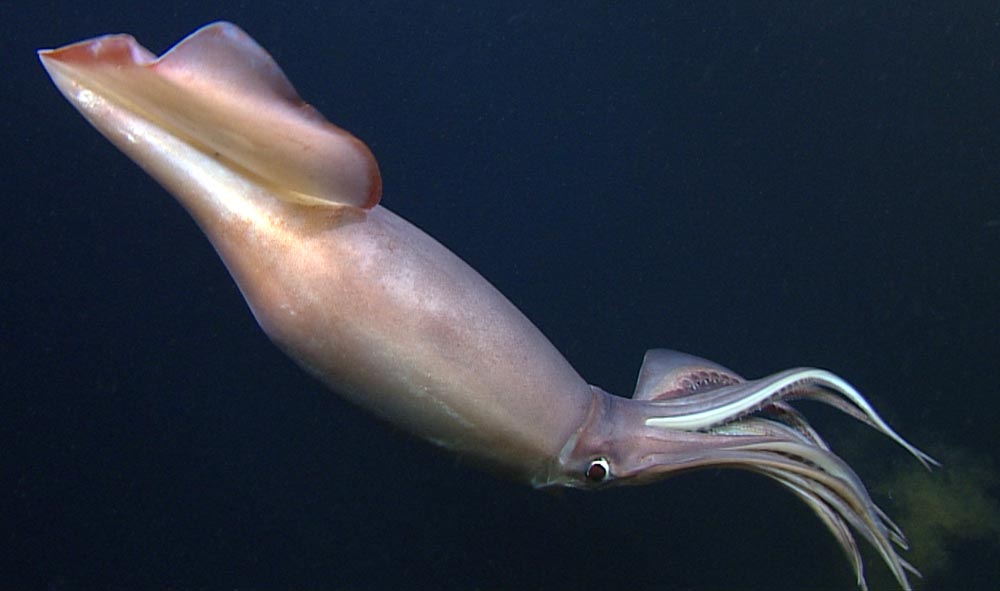
Dosidicus gigas
The Humboldt or 'jumbo' squid, Dosidicus gigas, is the largest species in the 'flying squid' family (Ommastrephidae). It can reach approximately 50kg and a mantle length of >1.2m (Nigmatullin et al., 2001). It is known only from the Eastern Pacific.
(In progress)
- A large ommastrephid (to mantle length >1.2m) found in the eastern Pacific from the Northwestern US to southern Chile
- Arms with very slender tips, becoming whip-like in subadults. Arms I with 60 to >200 pairs of suckers (other members of the subfamily have fewer than 35 pairs; Wormuth, 1976)
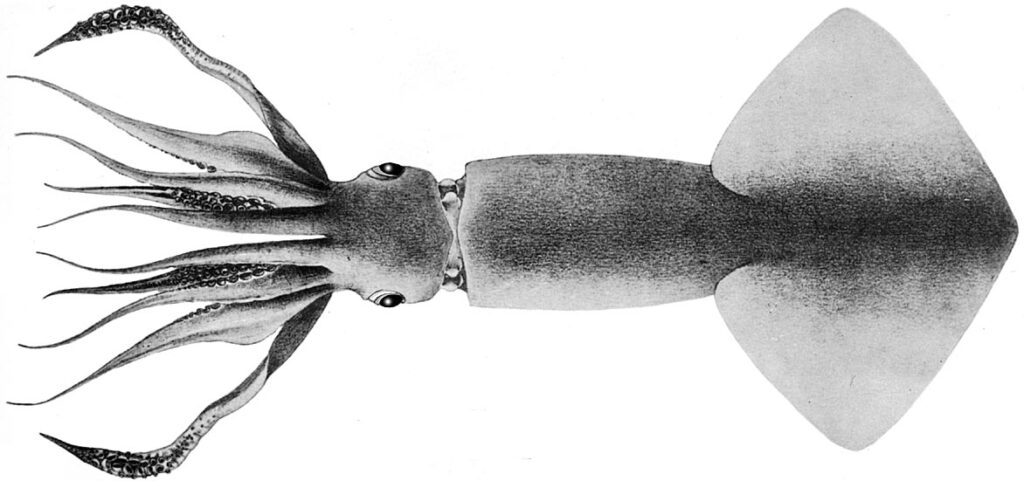
Male 'Humboldt' or 'jumbo' squid, Dosidicus gigas (ML 548 mm), dorsal view, showing whiplike arm tips. (C) Pfeffer 1912 
Arm II on a male D. gigas (ML 548mm) showing the morphological transition from the base of the arm (right) to mid-portion of the arm (centre) to the whip-like tip (left). (C) Pfeffer 1912
This page was generously supported by Will Ederer.
- Nigmatullin, Ch.M., Nesis, K.N., & Arkhipkin, A.I. (2001). A review of the biology of the jumbo squid Dosidicus gigas (Cephalopoda: Ommastrephidae). Fisheries Research 54: 9-19.
- Pfeffer, G. (1912). Die Cephalopoden der Plankton-Expedition. Ergebnisse der Plankton-Expedition der Humboldt-Stiftung. 2: 1-815.