
Batoteuthidae
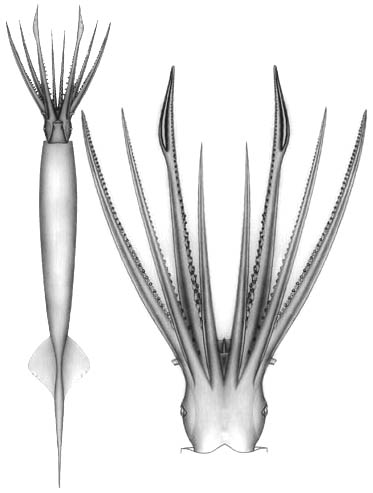
Figure. Female Batoteuthis skolops found in Antarctic waters, 350 mm ML (Tip to tail), Clyde F. E. Roper.
Batoteuthis skolops, the only species known in the family, is found only in Antarctic and subantarctic waters and little is known of its biology. It has a small head, a long tail and a very peculiar tentacle with six series of suckers on the club. It reaches a size of at least 35 cm ML.
A member of the chiroteuthid families ...
- with each tentacular club bearing suckers in six regular series.
Type locality: South Pacific Ocean about 1000 km southeast of Wellington, New Zealand in the region of the Antarctic Convergence (49° 57'S; 169° 01'W). This species is found in Antarctic and adjacent waters.
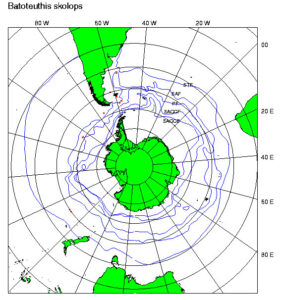
B. scolopes is a pelagic species apparently occupying deep water but no definitive information in available of its vertical distribution.
- Batoteuthidae (Young and Roper, 1968)
- The Bush-club Squid
- Batoteuthis
Nominal Genus-Level Taxa
Batoteuthis Young and Roper, 1968:185.
CURRENT SYSTEMATIC STATUS. -- Valid genus [fide Nesis (1987:240)] TYPE SPECIES. -- Batoteuthis skolops Young and Roper, 1968 by original designationNominal Species-Level Taxa (As Introduced Binomial)
Batoteuthis skolops Young and Roper, 1968:185, pls 1-6.
CURRENT SYSTEMATIC STATUS. -- Valid species [fide Nesis (1987:240)] TYPE REPOSITORY. -- NMNH Holotype 576029 [fide Roper and Sweeney (1978:13)] TYPE LOCALITY. -- 49°57'S, 169°01'W (Pacific Ocean)Type Repositories
NMH - National Museum of Natural History, 10th & Constitution Avenue, Smithsonian Institution, Washington, DC 20560, U.S.A. (formerly USNM). [For type catalog see Roper and Sweeney (1978)]- Arms
- Arms with suckers in two series.
- Have about 8-10 sharply pointed teeth on distal margins of inner rings
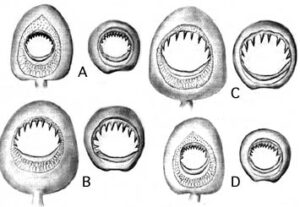
Figure. Oral view of arm suckers of a subadult (holotype) B. scolops, 51 mm ML, Antarctic waters, showing intact sucker and inner horny ring. A- Arm I. B- Arm II. C- Arm III. D- Arm IV. Drawings from Young and Roper, 1968.
- Tentacular club
- Club suckers in six series; club about 80% of tentacle length.

Figure. Oral view of tentacular club, B. skolops, holotype, 51 mm ML. Drawing from Young and Roper (1968). - Club exhibits characteristics of the chiroteuthid families:
- Keel absent.
- terminal pad absent.
- club not expanded.
- Club straight.
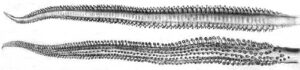
Figure. Drawings of oral and aboral views of the tentacular club of a subadult B. scolops (holotype), 51 mm ML, Antarctic waters. Clubs of larger squid are unknown. Drawings from Young and Roper, 1968.
- Suckers
- Club sucker ring bears approximately six small, conical, widely-spaced teeth on the distal margin.
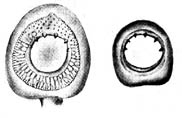
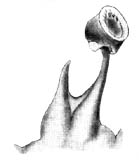
Figure. Oral view of club sucker (top left) and its inner horny ring (top right) and a lateral club-sucker, stalk and associated trabecula (bottom) of B. scolops (holotype). Drawings from Young and Roper, 1968.
- Club suckers in six series; club about 80% of tentacle length.
- Head
- Beak:
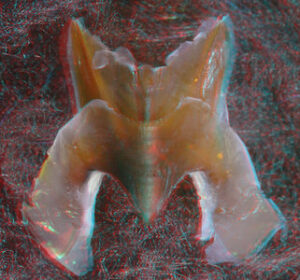
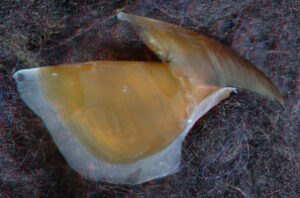
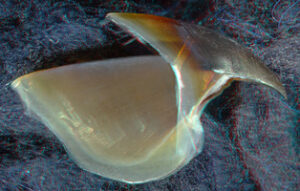
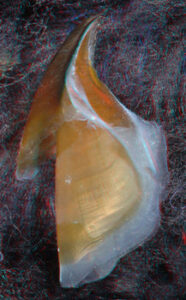
- Beaks of B. skolops are similar to those of Chiroteuthis spp. and those Mastigoteuthis spp. with tall lower beaks. More beaks of intermediate sizes needed for a proper description.:
- Lower beak:
B. skolops, sex ?, 90 mm ML, 1.9 mm LRL, Antarctic ocean. Photographs by R. Young. B. skolops, immature female, 350 mm ML (with tail), 4.5 mm LRL, Antarctic ocean. Photographs by R. Young. B. skolops, mature male, 351 mm ML (with tail), 4.1 mm LRL, Antarctic ocean. Photographs by R. Young. Side View 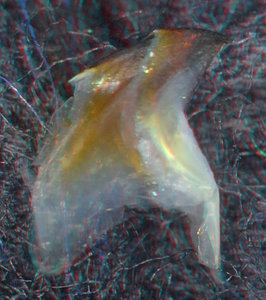
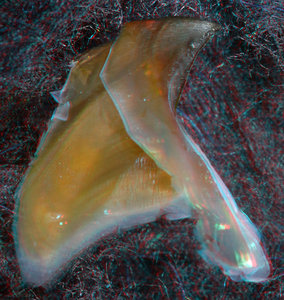
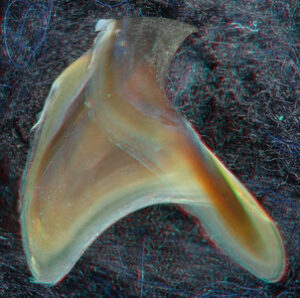
Oblique View 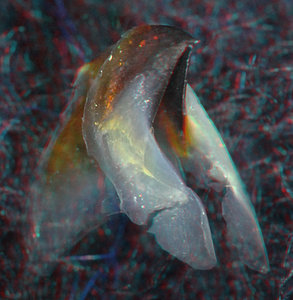
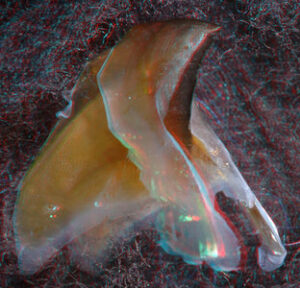
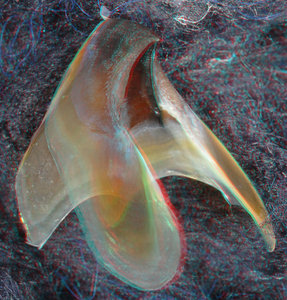
Oblique View 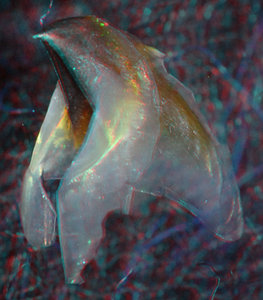
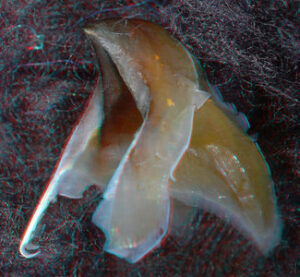
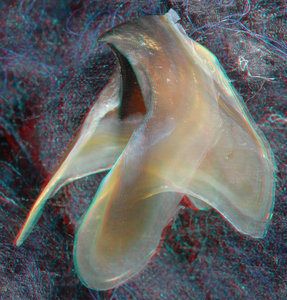
“Top” view 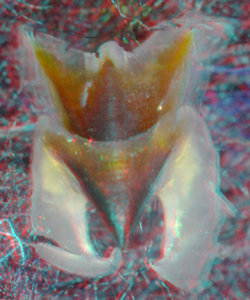
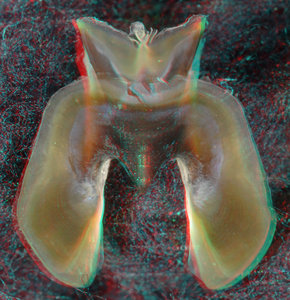
Oral view 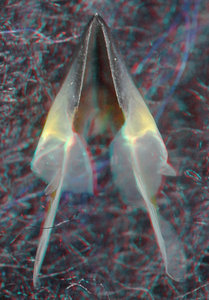
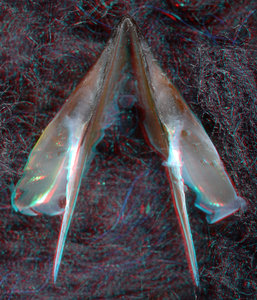
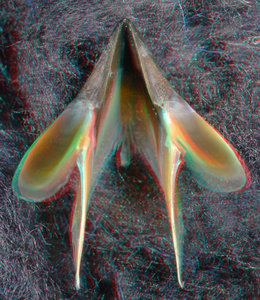
Front View 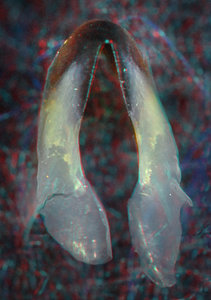
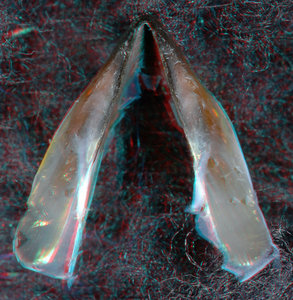
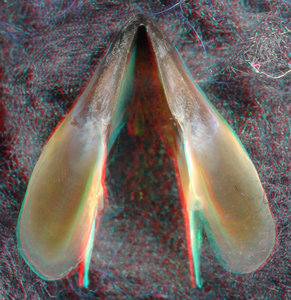
Posterior Oblique View 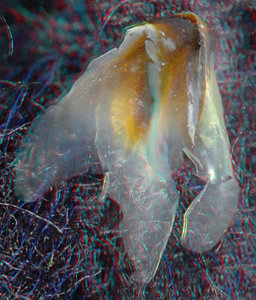
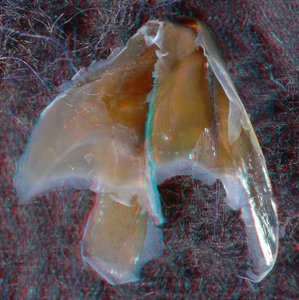
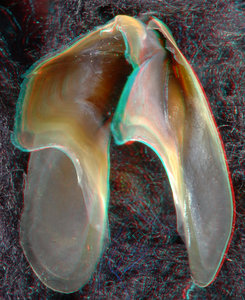
- About anaglyph 3D: Photographs here are in 3D, using anaglyph techniques which combines two photographs one in red and the other in cyan (blue + green) color. To get the 3D effect, you must use glasses with red and cyan lenses (filters) over your regular glasses. The form of the beak is far easier to interpret in 3D and we strongly recommend to the viewer that the glasses be obtained (this is especially helpful when viewing enlarged images - i.e. click on the image). These beak photographs were made using Red and Cyan Anachrome Aviator Glasses (see: http://www.anachrome.com/glassbuy.htm or http://www.amazon.com) which cost under $10.00 (USD).
- Upper beak:
B. skolops, sex ?, 90 mm ML, 2.0 mm URL, Antarctic ocean. Photographs by R. Young. B. skolops, immature female, 350 mm ML (with tail), 4.8 mm URL, Antarctic ocean. Photographs by R. Young. B. skolops, mature male, 351 mm ML (with tail), 4.2 mm URL, Antarctic ocean. Photographs by R. Young. Side View 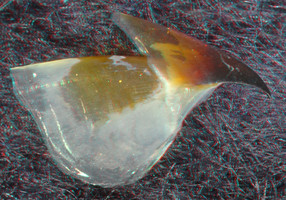
Oblique View 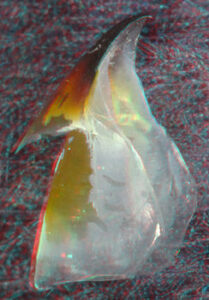
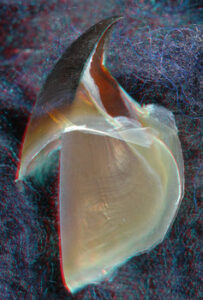
Oblique View 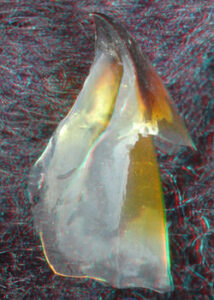
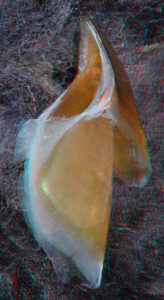
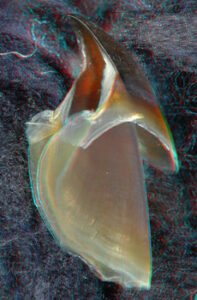
“Top” view 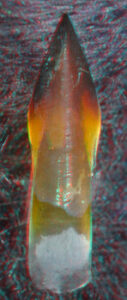
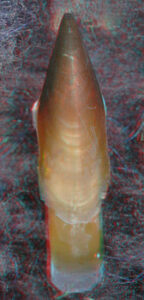
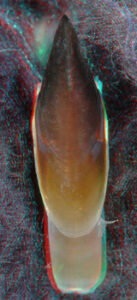
Oral view 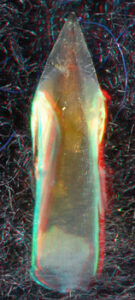
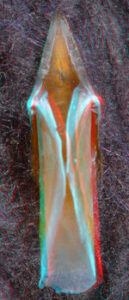
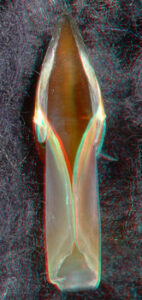
Front View 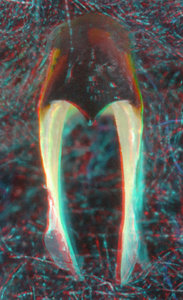
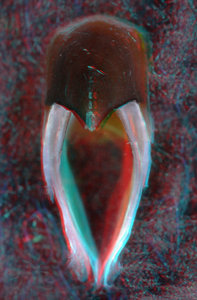
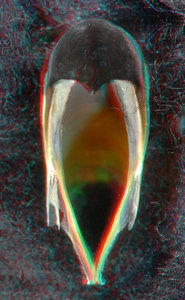
Posterior Oblique View 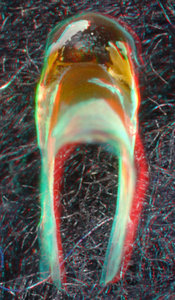
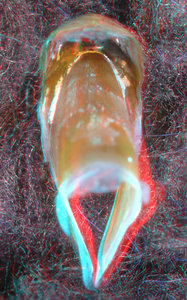
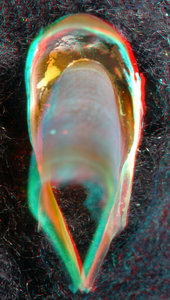
- Beak:
- Funnel
- Funnel locking-apparatus is distinctly curved.
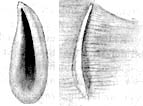
Figure. Frontal view of the funnel/mantle locking-aparatus of B. skolops, holotype. Left - Ventral view of funnel component. Right - Dorsal view of mantle component. Drawings from Young and Roper (1968).
- Funnel locking-apparatus is distinctly curved.
- Fins
- Short (about 20% of ML).
- Gladius and Tail
- Long secondary conus of gladius forms core of long, slender tail; length greatest in paralarvae.
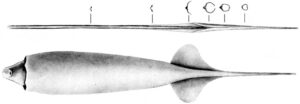
Figure. Batoteuthis skolops, 95 mm ML, female. Top - Ventral view of the gladius with cross-sections. Bottom - Ventral view of the funnel, mantle, fins and tail (head lost in capture). Drawing from Young and Roper (1968).
- Long secondary conus of gladius forms core of long, slender tail; length greatest in paralarvae.
- Photophores
- Large, subadult males with large aboral photophores occupying the tips of arms IV.
- Large, subadult females with small aboral photophores occupying the tips of arms IV.
Comments:
The visceral nucleus is located far anteriorly within the mantle cavity.The smallest known individual is 30 mm ML and the largest, 350 mm ML. Unfortunately, the largest specimen described with intact tentacles is the holotype. A few growth stages have been described. Paralarval and mature individuals are unknown.
Nesis, K. N. 1982. Abridged key to the cephalopod mollusks of the world's ocean. 385,ii pp. Light and Food Industry Publishing House, Moscow. (In Russian.). Translated into English by B. S. Levitov, ed. by L. A. Burgess (1987), Cephalopods of the world. T. F. H. Publications, Neptune City, NJ, 351pp.
Nesis, K.N. 1987.† Cephalopods of the World; Squids, cuttlefishes, Octopuses, and Allies. T.F.H. Publications, Neptune City, NJ, USA, 351 pages.
Roper, C.F.E. and M.J. Sweeney. 1978.† A catalog of the type-specimens of Recent Cephalopoda in the National Museum of Natural History.† Smithsonian Contributions to Zoology, 278:1-19.
Young, R. E. and C. F. E. Roper. 1968. The Batoteuthidae, a new family of squid (Cephalopoda; Oegopsida) from Antarctic waters. Antarctic Res. Ser. 2: 185-202.