

Genus B, new ?
The doratopsid paralarvae (42 and 96 mm ML) were first described as Chiroteuthis n. sp. (Nesis, 1974) and later identified as Chiroteuthidae n. gen. B (Nesis, 1982). These paralarvae are unusual in having six series of suckers present on the developing adult club. Although the importance of this feature is now uncertain, the structure of the funnel locking-apparatus may also be unusual.
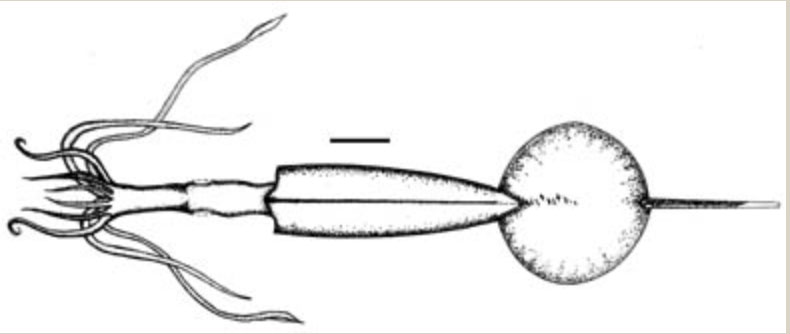
- Arms
- Arms IV not thicker but longer then others.
- Suckers on arms IV in one zigzag-like series.
- Suckers with 8-9 long, blunt teeth distally; smooth proximally.
- Tentacular club
- Doratopsis club with suckers in four series and developing adult club with suckers in six series.

Figure. Tentacule, 96 mm ML, scale bar = 5 mm, original. 

- Doratopsid club (=distal portion of club) with aboral elongated yellowish swelling between keel and protective membrane (indicated by arrow).
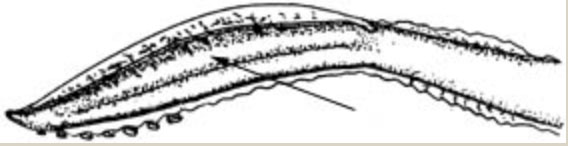
Figure. Aboral view of doratopsid portion of the club showing the unusual swelling (arrow), original. 
Figure. Aboral view of doratopsid portion of the club showing the unusual swelling (arrow), original.
- Suckers (developing club) with 3-4 sharp teeth, no prominent central tooth.
- Doratopsis club with suckers in four series and developing adult club with suckers in six series.
- Photophores
- Present, possibly unpaired, on ink sac.
- Funnel
- Locking apparatus with rounded antitragus, no tragus.
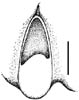
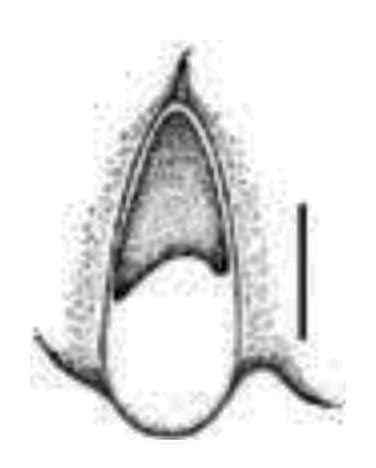
Figure. Funnel component of the funnel-mantle locking apparatus, scale bar = ??, original. Figure. Funnel component of the funnel-mantle locking apparatus, scale bar = ??, original.
- Locking apparatus with rounded antitragus, no tragus.

Comments
The swelling on the doratopsid club was originally described as a photophore (Nesis, 1974). Re-examination of the specimen shows that the swelling has no pigment nor lens and is located under skin covered with normal chromatophores. As a result, the function of this tissue is uncertain. Eyes were absent from the paralarva illustrated and the gladius was broken off at 22.5 mm beyond the fin. The total length of the paralarva, with tentacles, is about 180 mm.
The peculiar arrangement of suckers on the presumptive adult club is peculiar but does not necessarily indicate that the adult club will have six sucker series. Naef (1923) noted a similar situation in a doratopsis of C. veranyi from the Mediterranean. He states (p.389), "However, the longitudinal rows on the [presumptive adult club] become zigzag rows because the oblique and transverse rows are slightly displaced and alternating. This is thus not a simple quadriserial arangement but a transition between a quadriserial and an octoserial arrangement, which apparently later reverts to the basic quadriserial type." Young (1991) noted numerous series of sucker buds on the presumptive adult club of C. picteti doratopsis as had Sasaki (1929) in his small C. borealis (= C. picteti) doratopsis. Whether or not the distinct hexiserial arrangement of suckers on the presumptive adult club of this large doratopsis described here proves to be different, remains to be determined.