Chiroteuthidae
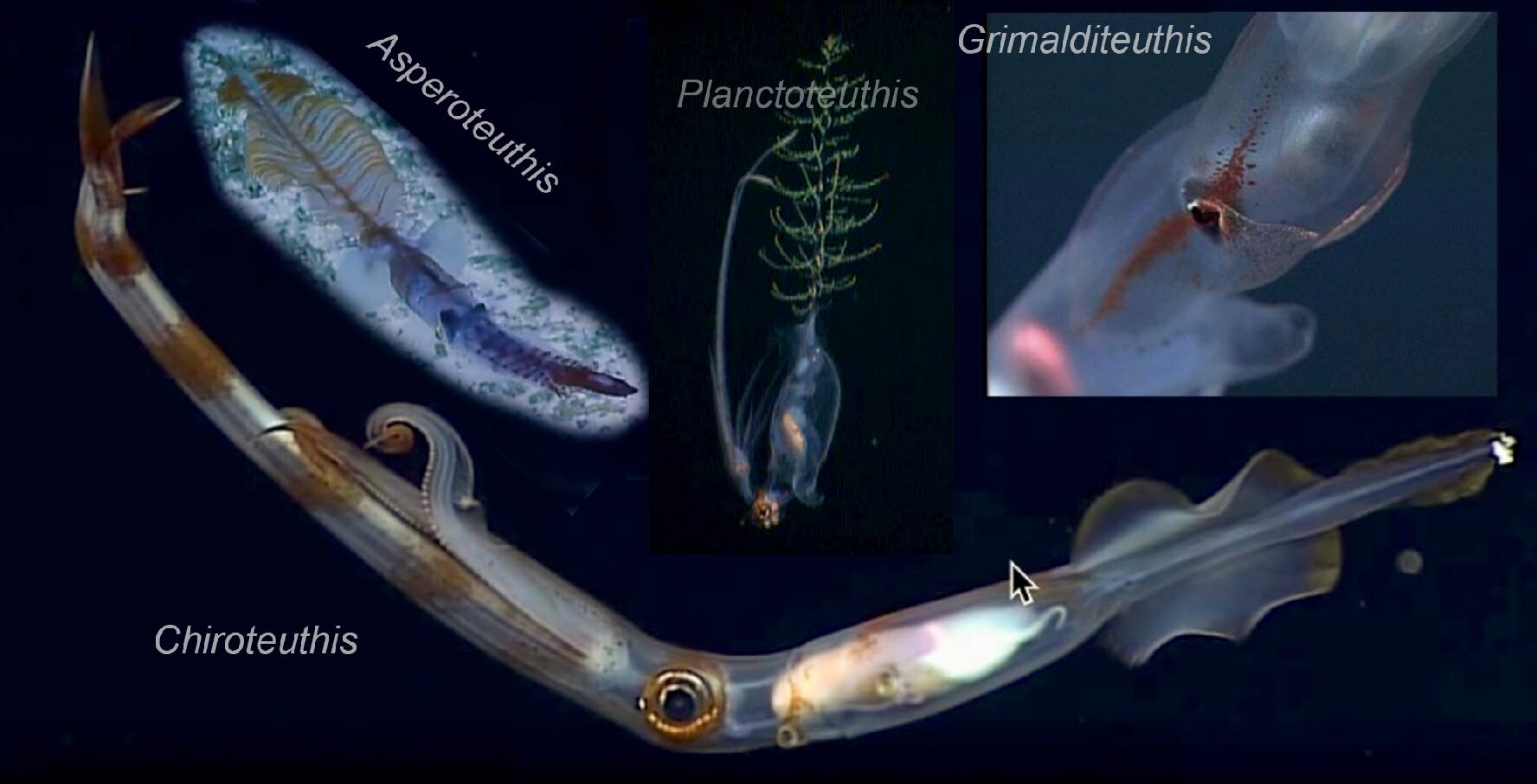
Chiroteuthids are small to medium in size (up to 78 cm ML), rather gelatinous, slow moving, deep-sea squids usually with elongate necks and slender bodies. Considerable morphological differences exist among genera, three of which, in the past, were placed in separate families. However, they all share a unique paralarva known as the doratopsis stage (see Life History below). Members of the family have numerous chambers in the arms, head and mantle filled with a light-weight fluid, ammonium cloride, that provides near-neutral buoyancy for the squids. Most species have extremely long, slender tentacles.
Characteristics of subadults and adults
- Arms
- Arms with suckers in two series.
- Tentacles
- Club very elongate and divided into two or three portions by symmetrical protective membranes except (in Planctoteuthis) and without dorsal keel and terminal pad except (in some Planctoteuthis).
- Club suckers in four series or absent (Grimalditeuthis).
- Head
- Head with an elongate neck and usually a brachial pillar.
- Funnel
- Funnel locking-apparatus often oval and often with tragus and antitragus.
- Tail 1. Tail, supported by gladius posterior to fins, with various decorations (see adjacent photographs), present in all genera, except lost in subadults and adults of Chiroteuthis spp.
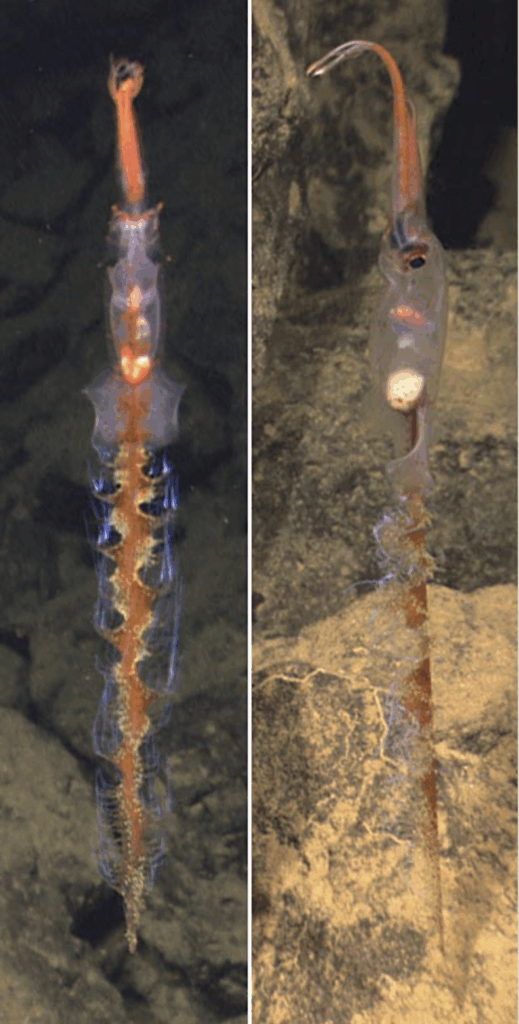
Figure . Dorsal (left) and side (right) views of the same Planctoteuthis sp., Indonesian waters, about 2000 m depth. From ROV video taken during the NOAA Ocean Exploration INDEX cruise.5. Tail, supported by gladius posterior to fins, with various "decorations" (see above photographs). - Photophores
- Present in Chiroteuthis spp., Asperoteuthis spp., Grimalditeuthis sp. but not in Planctoteuthis spp.
- Production of doratopsid paralarvae (see Life History).
Comments
The presence of a doratopsis paralarva is unique to the Chiroteuthidae and the "decorated" tail character is present in all the Chiroteuthidae it is alsopresent in Joubiniteuthis portieri (see . Additional features of the family include an indistinct eyelid sinus, absence of occipital folds, olfactory organs on long stalks (i.e. slender papillae, see below).

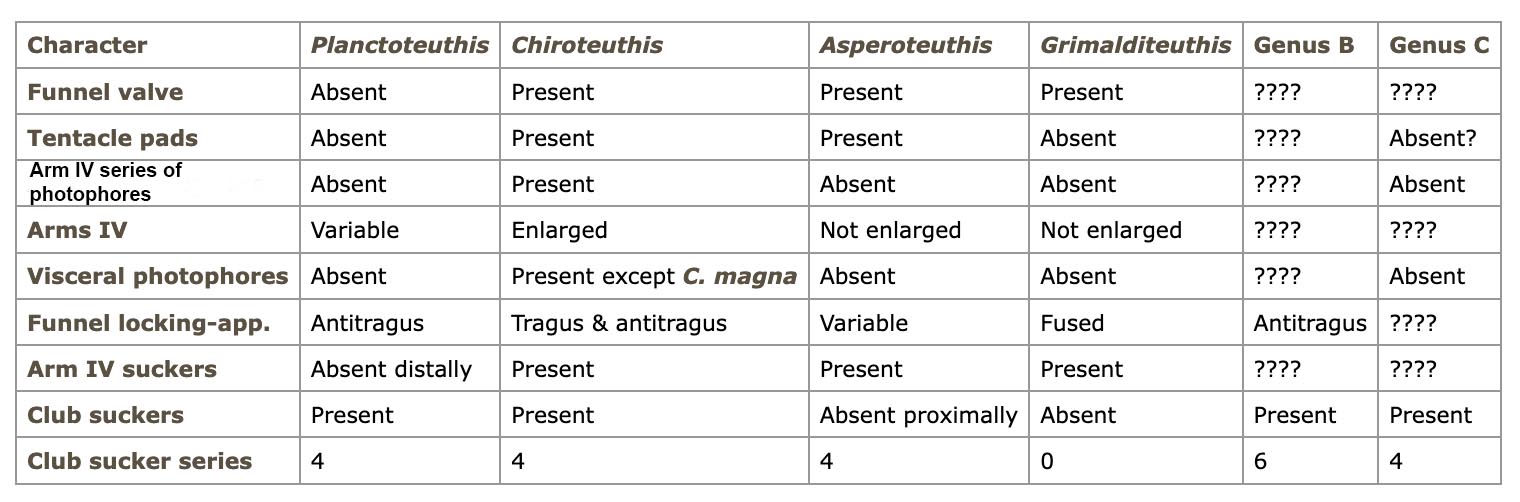
The following table compares subadults of the five chiroteuthid genera. Subadult characters for genus B, a paralarva, are assumed.
Comments
The position of the olfactory papilla is useful in separating genera in the doratopsis stage: The organ lies near the funnel in Grimalditeuthis, just behind the eye in Chiroteuthis and Planctoteuthis and half-way between the funnel and eye in Asperoteuthis.
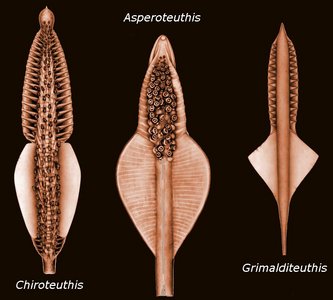
The relationships among the genera have not been examined with cladistics. In the Figure below, however, the first three tentacle clubs exhibit in an ordered series based on the progressive loss of suckers on the tentacular clubs of three genera. In (A) Chiroteuthis spp.the oral surface of the club contains suckers, in four series, throughout its length. In (B) Asperoteuthis spp. the proximal half of the club lacks suckers, while the distal half has suckers, also in four series. In (C) Grimalditeuthis sp.the entire oral surface of the club lacks suckers but the form of the club remains.
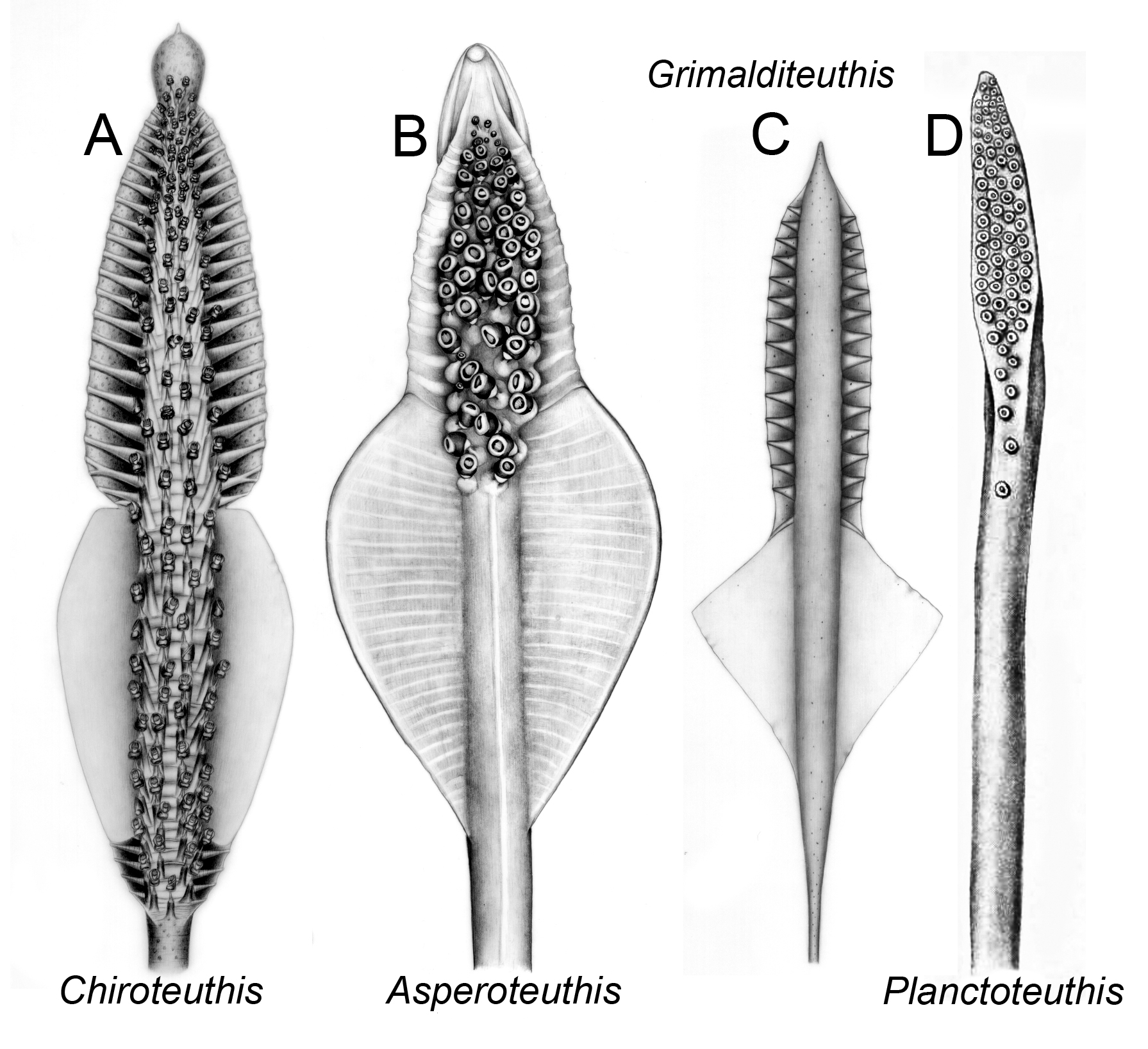
 The fourth club ( Fig. D) looks out of place; however if we were looking at fully developed doryteuthis clubs, rather than subadult clubs, they would look very similar. On this basis Roper and Young (1967), and others, suggested that Planctoteuthis spp. became a subadult in the early doratopsis stage but developod little beyond, while Chiroteuthis spp. continued to grow and change as they came close to transition into the subadult stage when they developed structures such as photophores (which Planctoteuthis spp. lacked) strange tentacle clubs derived from the doratopsis tentacle stalk and not the doratopsis tentacle club. Young (1991) based on much new paralarval data suggested that all taxa in the chiroteuthid families (except Planctoteuthis spp.) also developed subadult tentacle clubs from stalk suckers likely due to the loss of their ancestral tentacle clubs (see Chiroteuthid families page for the full explanation). as indicated by the absence of "ancestral" club structures such as club keels and club terminal pads.
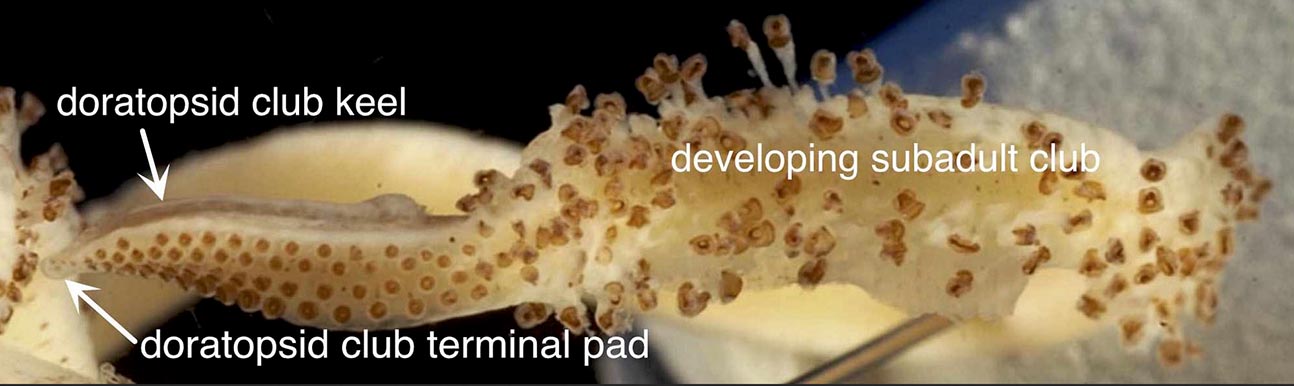
The distinctive doratopsid club poses a problem: Is this paralarval club similar to the true adult club (i.e., the ancestral adult club) that is absent in the chiroteuthid families? (See "Comments" on chiroteuthid-families page.)
Nomenclature
Uncertain species:
The taxonomic position of several specimens that anchor species names is uncertain.- Pfeffer (1912) described a small doratopsis as C. planctonica that he later placed in Planctoteuthis with reservations. The proper placement of this specimen is uncertain.
- Goodrich described a young Chiroteuthis from the Bay of Bengal that he called Doratopsis pellucida. The placement of this specimen is uncertain although it has often been assummed to be the young of C. macrosoma (= C. picteti) (e.g., Nesis 1982), presumably due to the proximity of type localities.
Chiroteuthid Doratopsis Stage
Doratopsis paralarvae possess the following characteristics at some point, at least, in their development:
- Elongate, chambered neck.
- Chambered brachial pillar.
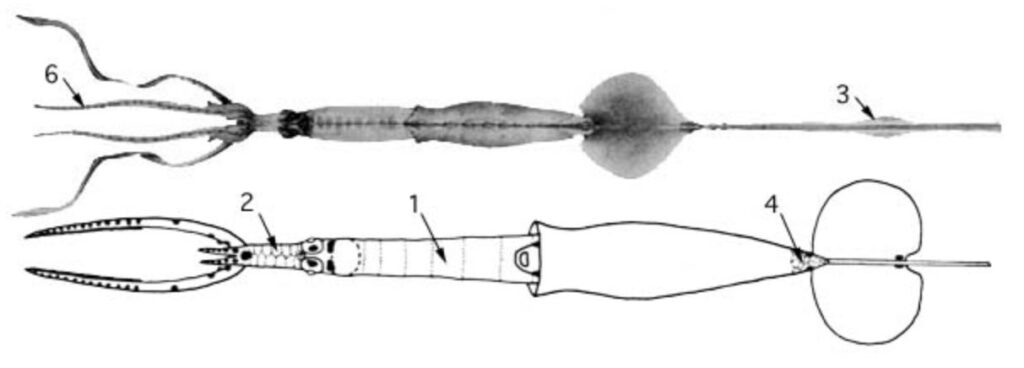
Figure. Top - Dorsal view of late doratopsis stage of Chiroteuthis veranyi, 35 mm ML. Drawing from Pfeffer, 1912. Bottom - Ventral view of a middle doratopsis stage of Chiroteuthis spoeli, 9.6 mm ML Drawing from Young, 1991. Numbers refer to the list of characters at the left - Gladius extending posteriorly beyond fins and supporting floatation structures or "ornamentation."
- Vesicular tissue in posterior region of mantle just anterior to fins.
- Vesiculate arms in advanced stages.

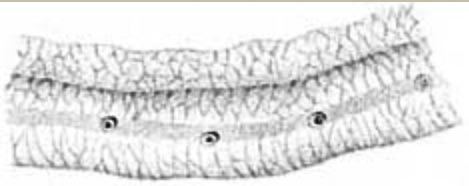
Figure. Oral view of portion of arm IV of Planctoteuthis exopthalmica, 9.5 mm ML, showing vesiculate tissue. Drawing from Chun (1910). 
- Ventral arms greatly elongate in advanced stages.
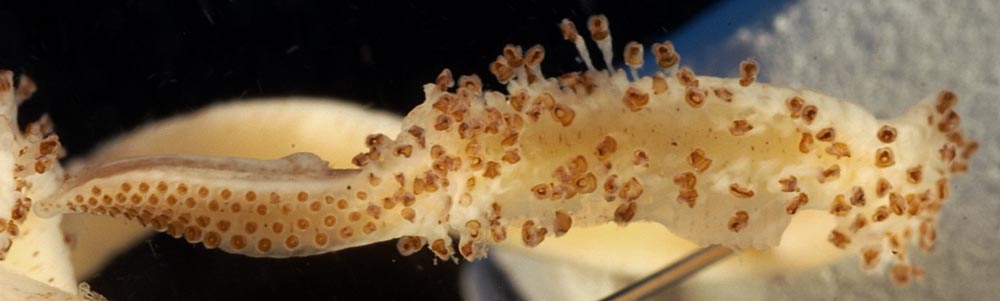
- Tentacular clubs of advanced stages with keels parallel to dorsal protective membranes along most of club length.

Figure. Oral view of a tentacle from an unidentified doratopsis, 28 mm ML. Note the paralarval club with both large suckers and a keel (but without division into manus and dactylus) and also the presumptive adult club of small suckers on the tentacular stalk. Drawing from Roper and Young, 1967. 
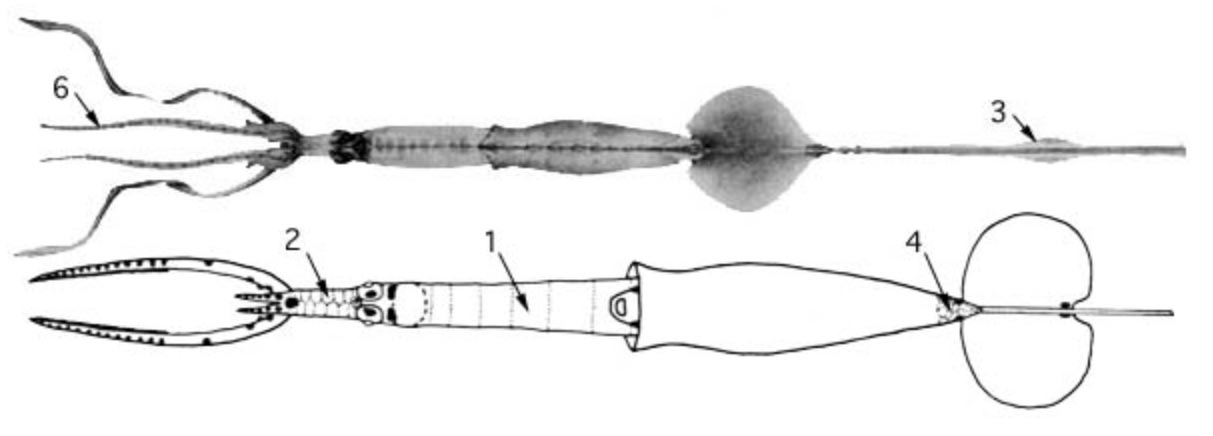
Most of these features are seen in these drawings of the doratopsis stage (numbers correspond to character numbers above):

Figure. Top - Dorsal view of late doratopsis stage of Chiroteuthis veranyi, 35 mm ML. Drawing from Pfeffer, 1912. Bottom - Ventral view of a middle doratopsis stage of Chiroteuthis spoeli, 9.6 mm ML. Drawing from Young, 1991.
References
Chun, C. 1910. Die Cephalopoden. Oegopsida. Wissenschaftliche Ergebnisse der Deutschen Tiefsee Expedition auf dem Dampfer "Valdivia" 1898-1899, 18(1):1-401.
Pfeffer, G. 1912. Die Cephalopoden der Plankton-Expedition. Ergebniss der Plankton-Expedition der Humboldt-Stiftung. 2: 1-815.
Roper, C. F. E. and R. E. Young (1967). A review of the Valbyteuthidae and an evaluation of its relationship with the Chiroteuthidae. Proc. U.S. Nat. Mus., 123: 1-9.
Young, R. E. (1991). Chiroteuthid and related paralarvae from Hawaiian waters. Bull. Mar. Sci., 49: 162-185.
Unusual features
Doratopsis paralarvae and the adult stages of some species have a gladius that extends well posterior to the fins and supports a remarkable "tail" that bears a variety of ornamentation, mostly of uncertain function. The ornamentation may be in the form of an oval structure superficially resembling a pair of fins, or a series of small flaps and/or oval bulbs. The latter contain anastomosing canals filled with fluid that is lighter than seawater (Hunt, 1996). The overall appearance in some cases is reminescent of a siphonophore (Vecchione, et al., 1992)
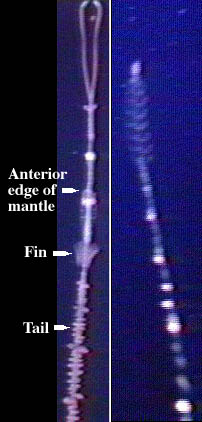
Figure. Still frames from a videotape of a doratopsis (left) of Chiroteuthis calyx and the siphonophore Nanomia bijuga (right) recorded in-situ from a remotely operated vehicle (ROV) in the eastern North Pacific off California (courtesy of the Monterey Bay Aquarium Research Institute). An AVI format video clip of this animal can be seen at Cephalopods in Action.
Chun, C. 1910. Die Cephalopoden. Oegopsida. Wissenschaftliche Ergebnisse der Deutschen Tiefsee Expedition auf dem Dampfer "Valdivia" 1898-1899, 18(1):1-401.
Pfeffer, G. 1912. Die Cephalopoden der Plankton-Expedition. Ergebniss der Plankton-Expedition der Humboldt-Stiftung. 2: 1-815.
Roper, C. F. E. and R. E. Young (1967). A review of the Valbyteuthidae and an evaluation of its relationship with the Chiroteuthidae. Proc. U.S. Nat. Mus., 123: 1-9.
Young, R. E. (1991). Chiroteuthid and related paralarvae from Hawaiian waters. Bull. Mar. Sci., 49: 162-185.