Mesonychoteuthis hamiltoni
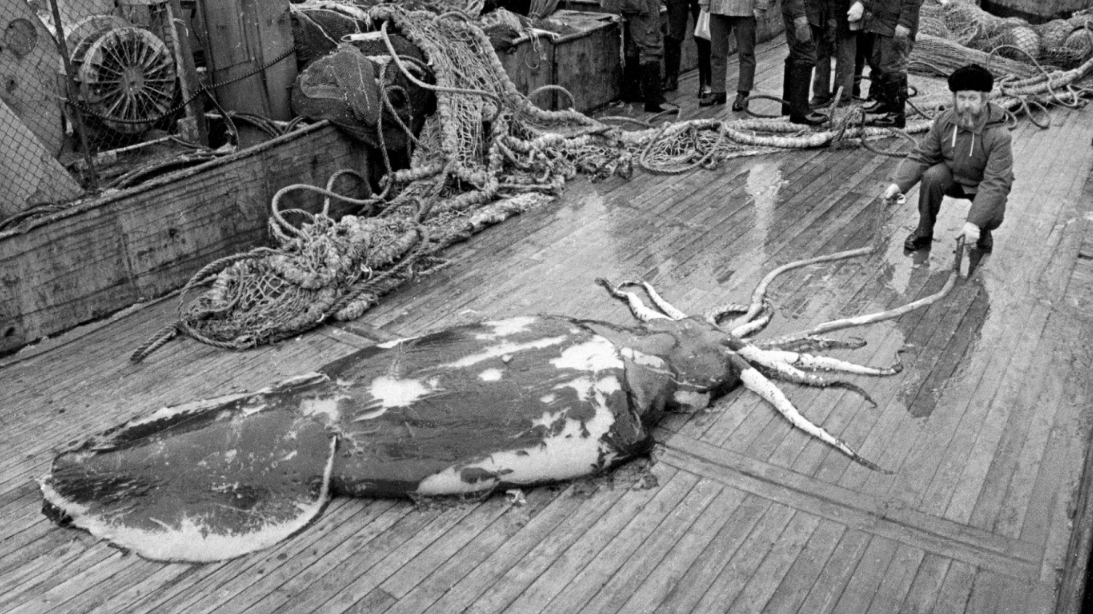
The 'colossal' squid, Mesonychoteuthis hamitoni, is the heaviest known invertebrate, reaching recorded weights of nearly 500kg. It can grow to 6-7m in length and is endemic to the Antarctic region, where it forms a major component of sperm whale diets.
Tentacles:
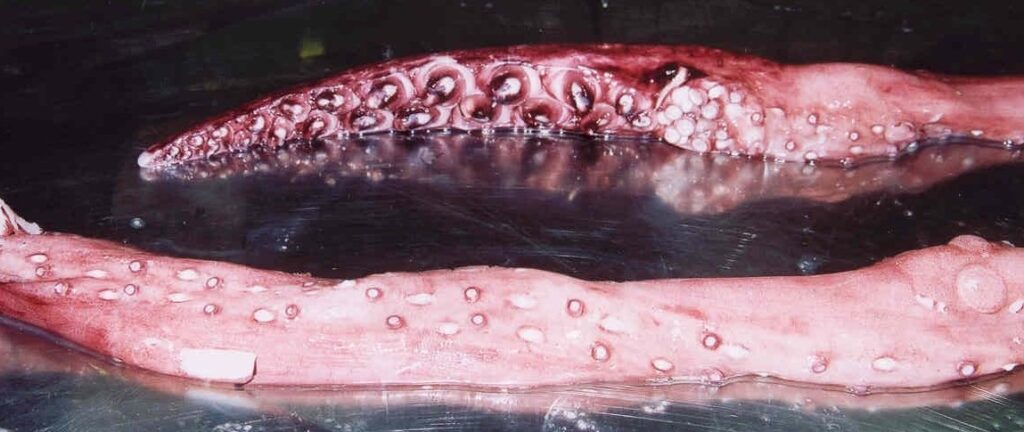
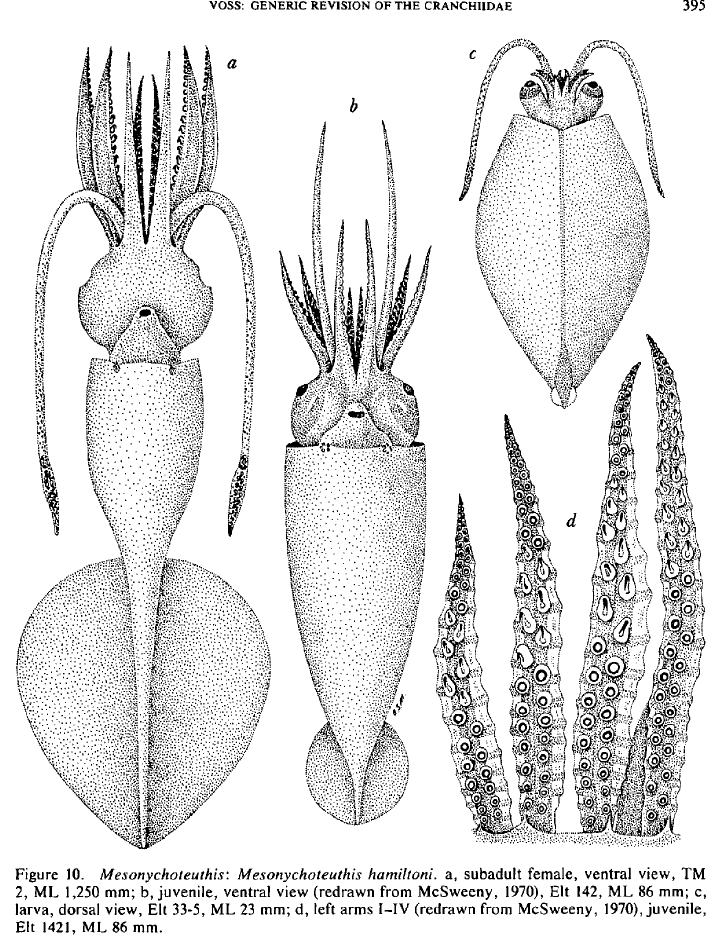
- Tentacle clubs slender (not expanded) with oval-shaped carpal locking pad and pairs of swivelling hooks
- Tentacle stalks with alternating pairs of small suckers and fleshy knobs that enable the tentacles to 'zip' together to function as a single unit
Arms:
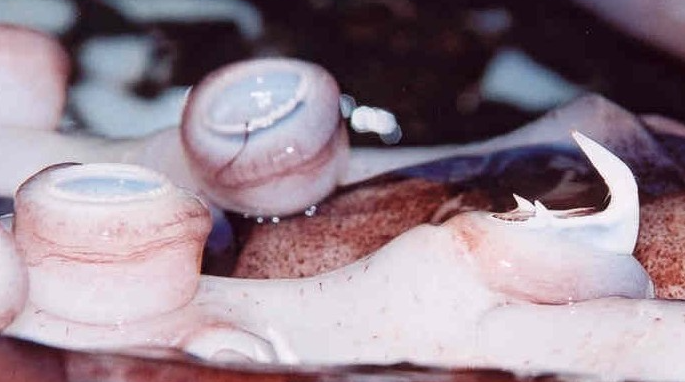
- Very robust, with 8-12 pairs of toothed suckers at the bases, 4-8 pairs of large sessile hooks in the mid section, and then 25-60 pairs of toothed suckers decreasing in size to the arm tips. Arm hooks present from about ML 45mm.
Head:
- Attached to the mantle at the dorsal midline and at the two ventral mantle-funnel fusions (characteristic of the family Cranchiidae)
- Eyes very large (to at least 35cm diameter), with two crescent-shaped photophores (light organs) on the ventral surface
- Beak very large and robust, lower rostral length (LRL) to at least 48mm
Fins:
- Very large and muscular, nearly circular, to at least 1m length and width
Size:
- Mature individuals not confirmed; large individuals examined to date appear to be submature. Largest examined specimens 5.5m total length (2.5m mantle length) and ~475kg; this species probably reaches 6-7m total length and >500kg
Live animals
Adult colossal squid have occasionally been encountered at the sea surface when they follow hooked toothfish on longlines up to the surface, sometimes becoming entangled in the lines. An example can be seen here. These animals are usually a bright to dark crimson colour, moving slowly, and have sometimes released the toothfish and swum back into deeper waters.
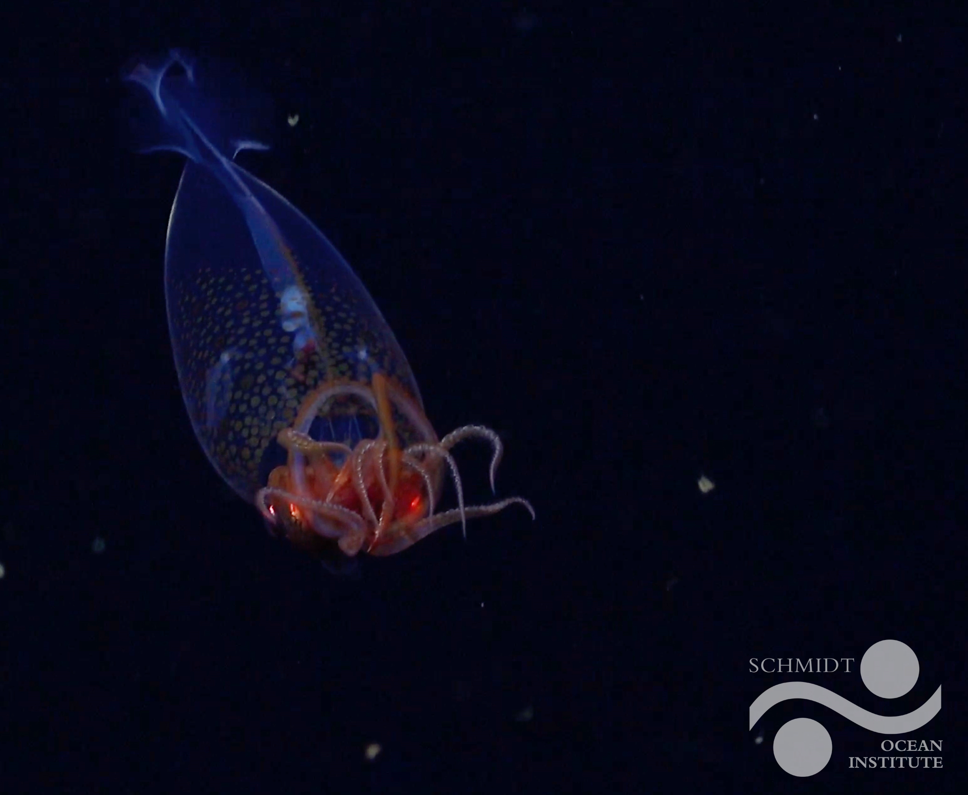
In March, 2025, a juvenile colossal squid was filmed at 593m near the South Sandwich Islands by Schmidt Ocean Institute's ROV SuBastian. The footage can be seen here. The squid appears to be about 30cm long and its appearance is typical for glass squids of this size, with a highly transparent body and iridescent eyes. The tentacle and mid-arm hooks can be seen clearly in the footage.
The colossal squid, M. hamiltoni, is the only species in the cranchiid ('glass' squid) genus Mesonychoteuthis.
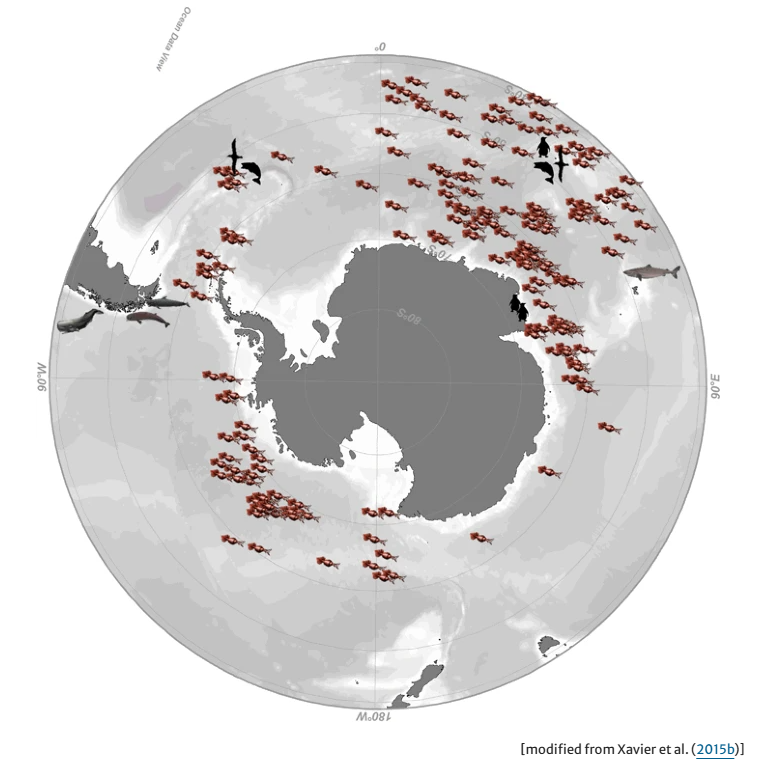
This species has a circum-Antarctic distribution and has been sampled from depths down to at least 2,000-2,200m (Rodhouse & Clarke, 1985). Young individuals have most frequently been encountered in the upper 500m of the water column and then presumably descend to greater depths with age/size.
Colossal squid
Giant Antarctic Cranch squid
Many aspects of the colossal squid's biology and life history remain unknown or only hypothesised. Spawning in this species seems to occur during austral summer months and Remeslo et al. (2019) reported mature oocyte (egg) size to be about 3mm.
Hatchlings are relatively large for squids, with several specimens ML 4.8-5.9mm still having fragments of chorion attached to the mantle (Rodhouse & Clarke, 1985). Young individuals closely resemble the related 'glacial glass' squid (Galiteuthis glacialis); their morphology was compared by Rodhouse & Clarke (1985), who reported that very small individuals (ML < 20mm) are difficult to distinguish but some differences were observed in tubercles at the nuchal fusion, the shape of the mantle and tail, and the length of the tentacles.
The maximum lifespan was recently estimated by Farnan (2024) as 5.2 years based on growth increments in the beaks (although the increments were interpreted as being deposited daily, which has not been confirmed in this species). Most records of this species to date have been prey remains in the stomachs of seabirds, marine mammals such as sperm whales, sharks, and toothfish. The original species description by Robson (1925) was based on two arm crowns taken from the stomach of a sperm whale killed near the South Shetland Islands in 1924.
Remeslo et al. (2015 and 2019) reported on the predatory interrelationships between the colossal squid and the Antarctic toothfish, and suggested that M. hamiltoni may primarily feed on mesopelagic fishes. Cherel and Hobson (2005) analysed the stable isotope values of 18 Southern Ocean squid species and found the colossal squid to occupy the highest trophic level. Rosa and Seibel (2010) estimated its metabolic and energy demands and hypothesised that it may use a 'sit and wait' / ambush predatory strategy.
Media:
- Young colossal squid footage from South Sandwich Islands, Schmidt Ocean Institute on YouTube
- The Deep-sea Podcast Ep. 56: Colossal Squid Birthday Special
- Article: Colossal squid: Eerie ambassador from the abyss
- Atlas Obscura short film: A colossal squid is hiding in New Zealand
- Live-streamed examination/dissection of a large colossal squid specimen at the Museum of New Zealand Te Papa Tongarewa in 2014: full 'Science Live' livestream (3.5 hrs) and highlights summary (7 minutes)
- Cherel, Y., & Hobson, K. A. (2005). Stable isotopes, beaks and predators: a new tool to study the trophic ecology of cephalopods, including giant and colossal squids. Proceedings of the Royal Society B: Biological Sciences, 272(1572), 1601-1607.
- Farnan, D. M. (2024). Age and growth of the Antarctic colossal squid Mesonychoteuthis hamiltoni (Master's thesis).
- McSweeny, E. S. (1970). Description of the juvenile form of the Antarctic squid Mesonychoteuthis hamiltoni Robson. Malacologia, 10(2), 323-332.
- Remeslo, A. V., Yakushev, M. R., & Laptikhovsky, V. (2015). Alien vs. Predator: interactions between the colossal squid (Mesonychoteuthis hamiltoni) and the Antarctic toothfish (Dissostichus mawsoni). Journal of Natural History, 49(41-42), 2483-2491.
- Remeslo, A., Yukhov, V., Bolstad, K., & Laptikhovsky, V. (2019). Distribution and biology of the colossal squid, Mesonychoteuthis hamiltoni: New data from depredation in toothfish fisheries and sperm whale stomach contents. Deep Sea Research Part I: Oceanographic Research Papers, 147, 121-127.
- Robson, G. C. (1925). XXXIX.—On Mesonychoteuthis, a new genus of Œgopsid Cephalopoda. Journal of Natural History, 16(92), 272-277.
- Rodhouse, P. G., & Clarke, M. R. (1985). Growth and distribution of young Mesonychoteuthis hamiltoni Robson (Mollusca: Cephalopoda): an Antarctic squid. Vie et Milieu/Life & Environment, 223-230.
- Rosa, R., Lopes, V. M., Guerreiro, M., Bolstad, K., & Xavier, J. C. (2017). Biology and ecology of the world’s largest invertebrate, the colossal squid (Mesonychoteuthis hamiltoni): a short review. Polar Biology, 40, 1871-1883.
- Rosa, R., & Seibel, B. A. (2010). Slow pace of life of the Antarctic colossal squid. Journal of the Marine Biological Association of the United Kingdom, 90(7), 1375-1378.
- Voss, N. A. (1980). A generic revision of the Cranchiidae (Cephalopoda; Oegopsida). Bulletin of marine science, 30(2), 365-412.