
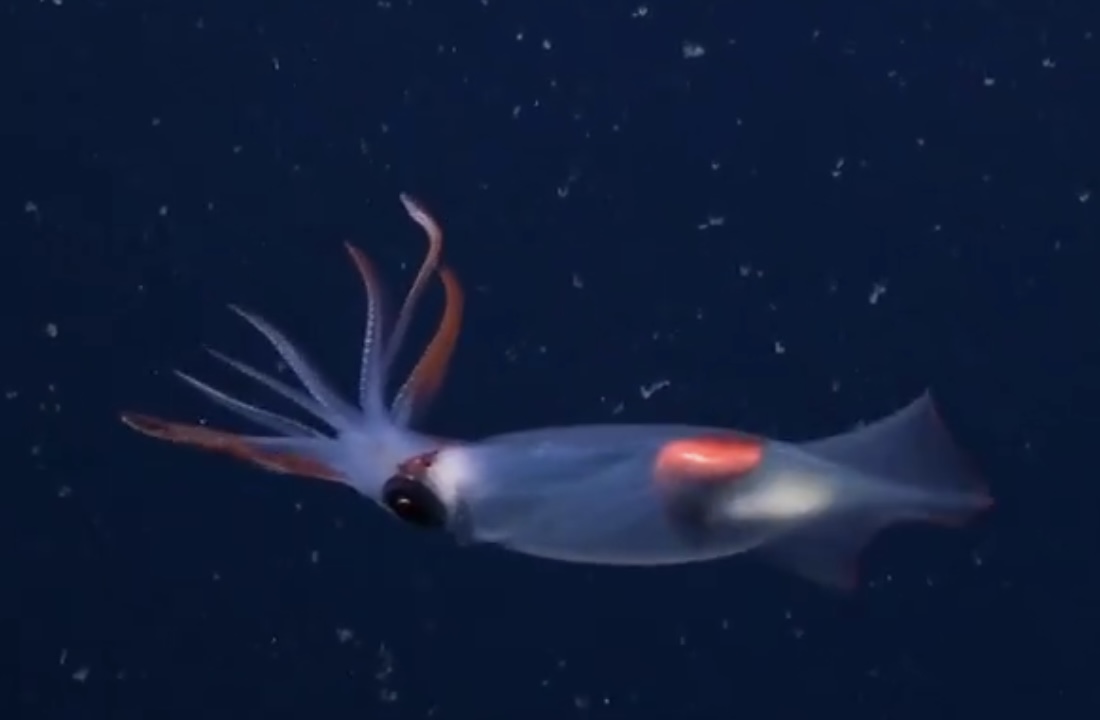
Slosarczykovia
Slosarczykovia are relatively small squid with a maximum mantle length of ~20 cm. The species within this genus (Slosarczykovia circumantarctica), while common, has not been critically reviewed.
- Arms:
a. Arm sucker ring with lots of variation: from completely smooth margins - to few densely packed teeth - to many loosely packed teeth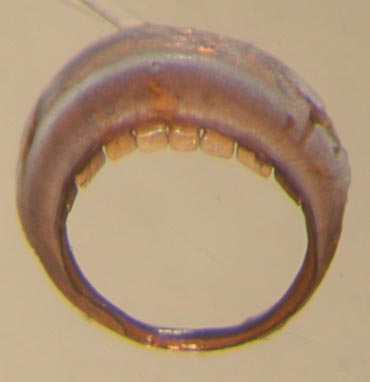
Oral view of the sucker ring of a large arm sucker of S. circumantarctica. Photograph by R. Young. - Tentacles:
a. Largest suckers from proximal manus 3/4 diameter of largest proximal dactylus sucker.
b. Tentacles lack a carpal-fixing apparatus.
c. 13 small "carpal suckers form a uniform, single series along dorsal margin of the manus.
d. Weakly differentiated suckers on tentacular club.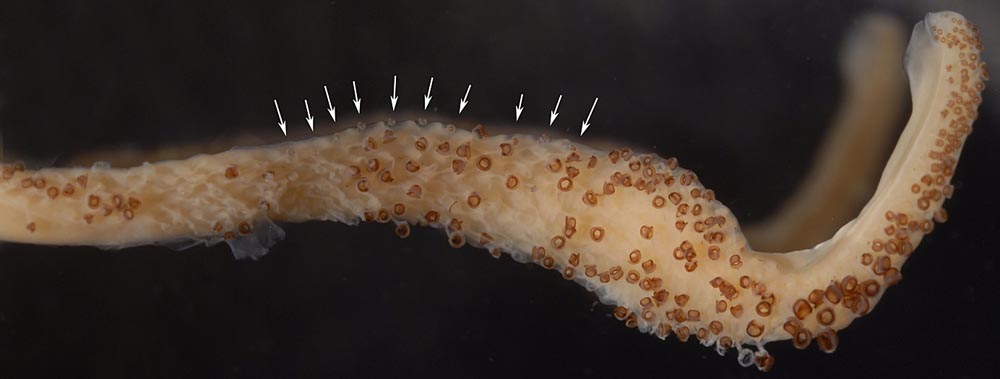
Oral view of tentacular club of Slosarczykovia circumantarctica. Arrows pointing at "carpal" suckers on dorsal side of club. Photograph by R. Young - Fibrous Net
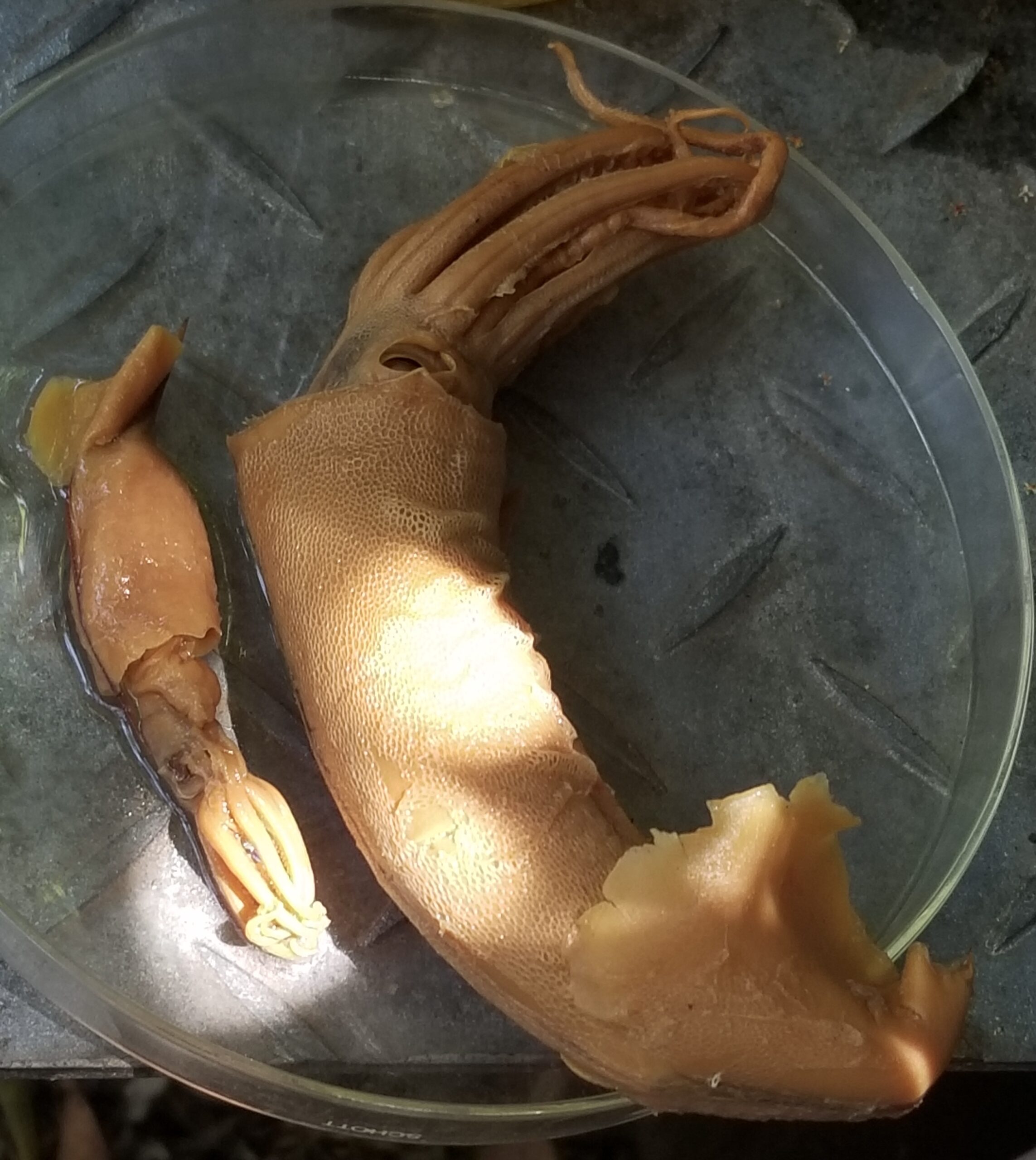
a. Fibrous integumental net that covers the fins, mantle, head, and arms.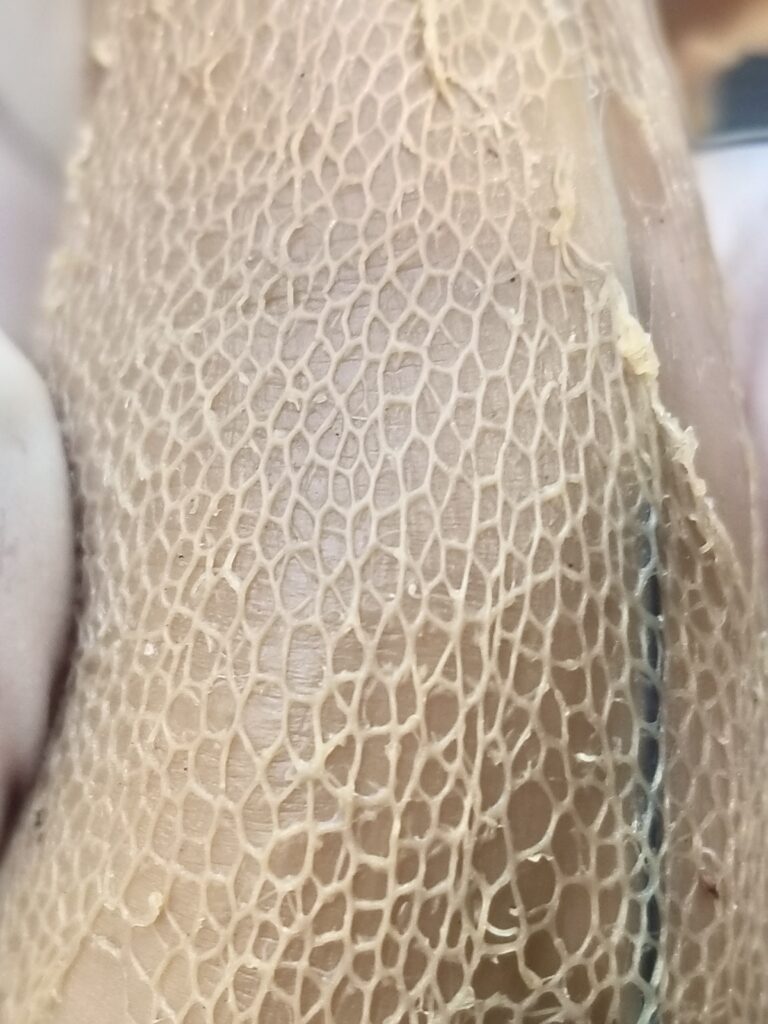
Reticulated skin net of Slosarczykovia circumantarctica holotype. Photo by Austin Horenkamp
Slosarczykovia is a monotypic genus consisting solely of Slosarczykovia circumantarctica.
Slosarczykovia are distributed in circumantarctic waters. Concentrations of records mainly come from around the South Sandwich Islands. The depth range is relatively unknown, but individuals have been detected to at least 1115m (Zabroda et al., 2020).
Type Locality: Opposite of Wilkes Land Antarctica
Epipelagic, mesopelagic, and bathypelagic.
Slosarczykovia was shown to have relatively high habitat importance in comparison to other cephalopods in Antarctic, Scotia, and Sub-Antarctic habitats (Reisinger et al., 2022).
The phylogenetic relationships between Slosarczykovia and other oegopsid families has not yet been explored. However, Slosarczykovia shares many characters with Brachioteuthis including having a weakly differentiated club, a club that has many suckers particularly at the proximal manus, simple funnel locking cartilage, and biserial suckers on arms I-IV (Lipinski, 2001).
Large muscular brachioteuthids measuring upwards of 200 mm mantle length. The fins, mantle, head, and arms are covered in a reticulated skin net. Unlike other brachioteuthids, Slosarczykovia lack tubercles on the mantle in both mature males or in females. The mantle is long and relatively slender (MW ~19% ML). Fins are rhomboid with the FLI ~40% and the FWI ~55%.
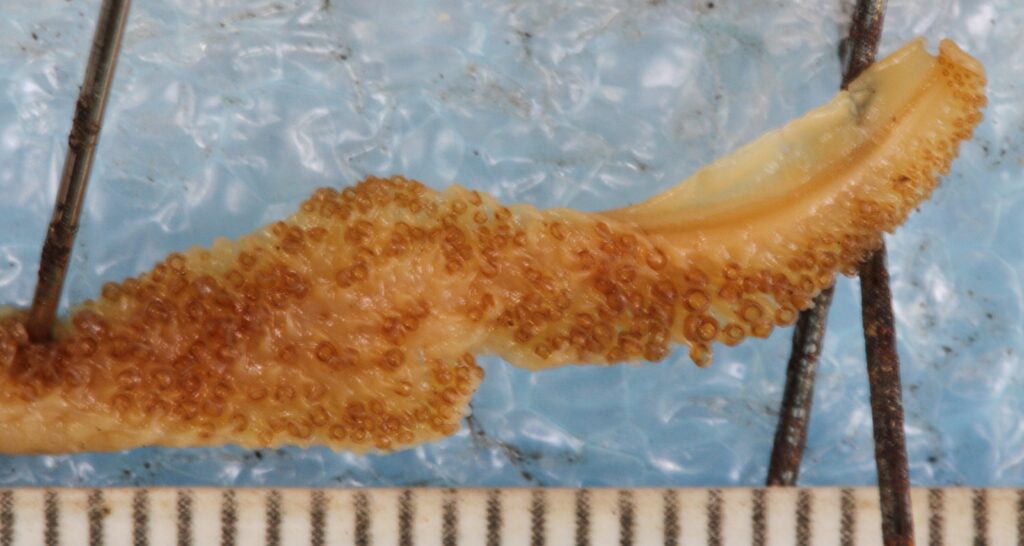
Arms short (females: A1I 34%, A2I 46%, A3I 42% A4I 36%; males: A1I 35%, A2I 47%, A3I 42%, A4I 40%).The arm formula is II>III>IV>I. In females, sucker rings of arms I-IV are smooth; while in males, 1-4 low, inconspicuous teeth can form. Sucker rings strongly developed, with short stalks. No sucker enlargement and/or modification (hectocotylus). Each arm has a median groove instead of a keel. Tentacles short, followed by a long club. Parts of the club are weakly differentiated. No apparent fixing apparatus. Seven small suckers at the base of the club (on the stalk). As the club widens slightly, ~10 loose series of suckers form on the manus and are sparsely distributed (Figure 1). Diameter of the largest dactylus sucker is ~1/3rd larger than the largest sucker on the manus. Suckers appear subequal, except on dorsal marginal row, and along the stalk, where the suckers are smaller. There are 11-13 sharp, long teeth present on the largest sucker rings.
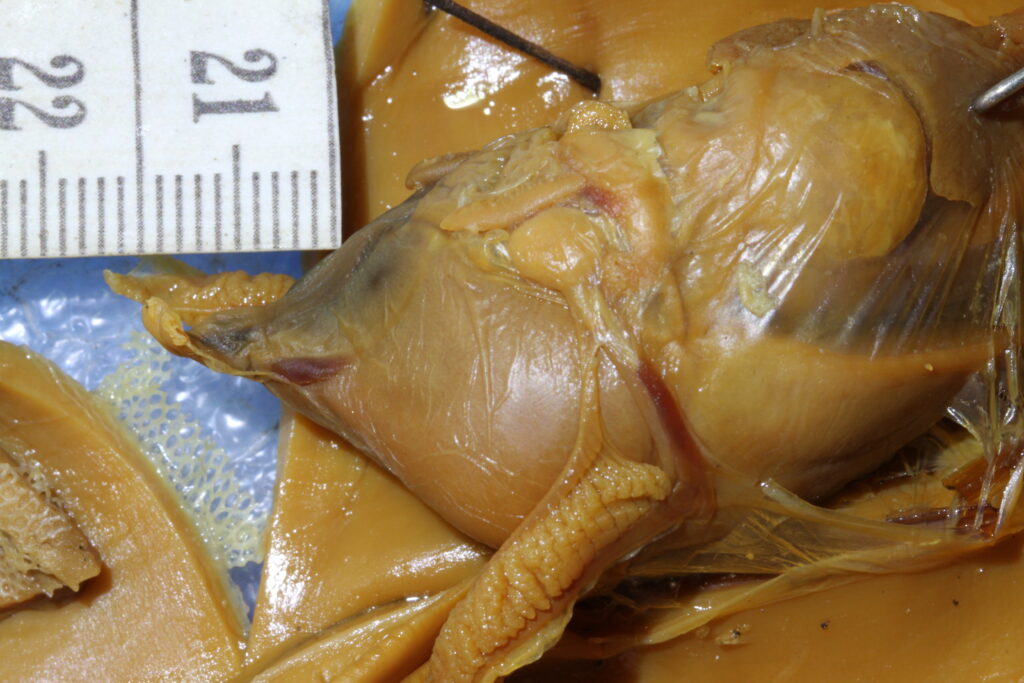
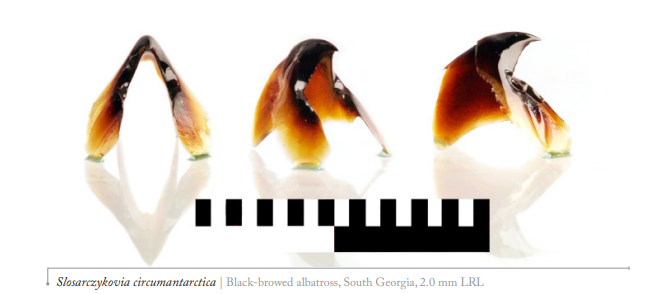
A thin luminous tissue is present around the lens, but not on the ventral side of the eye. Gladius has a long, narrow straight rachis, and a well developed conus (33% of the gladius length) (Figure 2). The liver is globular, and partially open ventrally (Figure 3).

The life history for this genus remains unknown.
Lipinski, M. R. (2001). Preliminary description of two new species of cephalopods (Cephalopoda: Brachioteuthidae) from South Atlantic and Antarctic waters. Bulletin of the Sea Fisheries Institute, 1(152), 3-14.
Lipinski, Marek and Richard E. Young. 2019. Slosarczykovia . Slosarczykovia circumantarctica . Version 20 August 2019 (under construction). http://tolweb.org/Slosarczykovia_circumantarctica/24102/2019.08.20 in The Tree of Life Web Project, http://tolweb.org/
Reisinger, R. R., Brooks, C. M., Raymond, B., Freer, J. J., Cotté, C., Xavier, J. C., ... & Hindell, M. (2022). Predator-derived bioregions in the Southern Ocean: Characteristics, drivers and representation in marine protected areas. Biological Conservation, 272, 109630.
Zabroda, P., Pshenichnov, L., & Marichev, D. (2020). Benthic wildlife underwater video recording during longline survey in Weddell Sea. Ukrainian Antarctic Journal, (2), 75-83.